
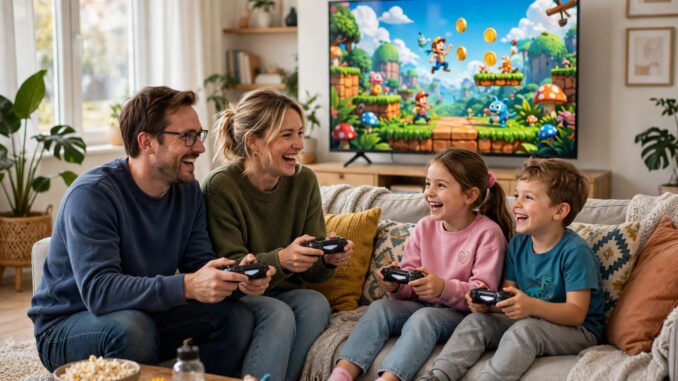
The hard part of family gaming in 2026 is not finding a good game. It is choosing between hundreds of good ones without buying the wrong thing. Shelves and store pages overflow with polished, well-labelled choices, and every cover promises family fun. Parents who choose well do not read a hundred reviews. They run a short filter, in a fixed order, and let it rule out most titles in about ten minutes.
Compare by the decision that actually matters: who is playing, together or alone, and what the game will ask of them beyond the sticker price. Age, company, and money checks come first. Only then does it make sense to compare titles band by band.
The Ten-Minute Filter
Age First
Match the rating to the youngest player in the room, not the oldest and not the average. A game that suits a ten-year-old can be wrong for the six-year-old sitting beside them with a second controller. Start every search with the ESRB ratings lookup, which shows the rating and the reasons behind it for each title.
Then read the content descriptors, not just the letter. Two games can share the same rating and feel completely different. Descriptors name the specifics: cartoon violence, mild language, suggestive themes, and so on. A child who handles slapstick cartoon conflict may still be upset by tense scenes or crude jokes. The descriptors tell you which kind of content earned the rating, and that detail is where good choices are made.
For a plain-language companion to the ratings themselves, video game age ratings explained for parents walks through what each level means in practice and where parents most often misread it. Read it once and the filter below becomes quick habit.
Co-op or Solo Next
Decide whether you want to play together. Co-op games, where players work toward the same goal, change the whole experience for families. An adult can guide, rescue, and laugh through mistakes alongside a child. Solo games can be excellent too, but they ask a child to handle setbacks, reading, and puzzles alone. Neither is better in general. They suit different evenings, different ages, and different goals. Name which one you are shopping for before you compare titles, or you will compare games that were never rivals.
The Money Check
Check how the game makes money after you bring it home. A paid game is usually the safer buy for children, because the price is the price. Free-to-play games earn through in-game purchases instead, which means spending prompts sit inside the play itself. Look for the descriptors that flag this. In-Game Purchases tells you the game sells items or currency. Users Interact tells you players can communicate or share content online. Neither label makes a game bad. Both labels mean a parent should set spending and chat controls before the first session, not after a surprise charge.
The Options by Age Band
Ages 4 to 7: Exploration and Creativity
For the youngest players, choose gentle worlds with low reading load, no harsh fail states, and goals a child can grasp by watching. Animal Crossing: New Horizons (E) lets children decorate, collect, and wander at their own pace on a calm island. Super Mario Bros. Wonder (E) offers bright platform play that adults can join, with forgiving help for new players. Untitled Goose Game (E) turns mischief in a small village into short, funny puzzles that work well in brief sessions with a parent beside the child.
Verdict for this band: pick calm and joinable over long and story-heavy. Short sessions, shared laughter, and worlds that never punish a beginner will build a love of games far better than a big adventure a young child cannot follow.
Ages 8 to 12: Adventure and Problem-Solving
Older children can handle deeper systems, longer goals, and mild peril. Minecraft (E10+) remains the standout building and survival choice, especially in creative play where children design freely. LEGO Star Wars: The Skywalker Saga (E10+) wraps humour, exploration, and simple combat in a story many families already know. Kirby and the Forgotten Land (E10+) gives colourful adventure with a friendly difficulty curve and a helpful co-op option. Rocket League (E) blends driving and soccer into quick matches that reward practice without a heavy story.
Verdict for this band: this is the richest range for value. Any of these four can hold attention for months, and all reward problem-solving or teamwork. Choose by your child’s taste: building, stories, platform adventure, or sport.
Ages 13 and Up: The Bridge Years
As children move into their teens, ratings move to T and the parent’s job changes. Blocking gives way to discussing. Teens will encounter stronger themes through friends and media regardless of what sits on your shelf, so the useful skill becomes talking about content: what a game shows, how it treats its characters, and where your family’s lines sit.
Verdict for this band: stay involved rather than stepping away. Play or watch early sessions, ask what your teen thinks of a game’s choices, and keep the ratings and descriptors in view together. A teen who can explain why a title carries its rating is learning exactly the judgement you want them to carry into adult media.
All Ages Together
Some evenings need everyone on the same couch, from a five-year-old to a grandparent. Mario Kart World (E) is built for that spread, with racing that lets different skill levels share a track and still have fun. Overcooked 2 (E) turns cooking into cheerful chaos where communication matters more than reflexes, and where failure is usually funny. Jackbox party games suit larger groups and phones-as-controllers play, but check each pack’s rating before buying, since packs differ.
Verdict for shared play: choose games where losing is entertaining and rounds are short. If a game makes the youngest player wait, watch, or feel blamed, it will not survive a second family night no matter how strong the reviews are.
The Money Comparison
Honest pricing matters, because family gaming costs have shifted. Big first-party games now launch around $70 to $80. Mario Kart World launched at $79.99, which sets the top end of what a single family title can cost on release day. Against that, many of the best family games are smaller titles at $10 to $25, or older hits bought on sale for far less than launch price. A patient family can build a strong library without paying top price for every game.
Hardware costs more than it did as well. Console prices rose during 2026, and recent US list prices tell the story: Nintendo Switch 2 at $499.99, PlayStation 5 from $599.99 for the Digital model and $649.99 for the disc model, and Xbox Series S from $499.99. Treat those as recent list prices and check current prices before buying, since retailers and bundles change the real figure. If a console is already in the home, the smart spend is almost always games and a second controller, not new hardware.
The Traps
Buying on cover art is the oldest trap. A bright, friendly cover can hide tense content, heavy reading, or relentless purchase prompts. The rating and descriptors on the back, or on the store page, take thirty seconds to check and prevent most bad buys.
Assuming cartoon means gentle is the second trap. Animation style says nothing about difficulty, themes, or tone. Some cartoon games are demanding or cheeky in ways that suit older children only. Read the descriptors and watch a few minutes of real play before deciding.
Forgetting online chat is the third trap. A game can be mild in its own content and still expose children to strangers’ voices and messages. Check for the Users Interact descriptor, set communication controls at the console level, and favour friends-only play for younger children.
Tools help here as much as lists do. Common Sense Media and its parent reviews add context that a rating letter cannot: what parents and children actually found intense, funny, or upsetting, and what age reviewers suggest in practice. Pair that view with the official rating and you have both the label and the lived experience.
The Recommendation
Start narrow. Buy one E or E10+ co-op title matched to your youngest player, using the filter above, and play it with them for the first sessions. Those early hours teach you more about your child’s taste, patience, and reading level than any list can, and they set the pattern that games are shared family time rather than a closed door.
Keep a simple family rule while the library grows: new games get checked before they get played, and any title with online interaction starts with controls set and a parent nearby. Children accept that routine easily when it applies to every purchase from the start, rather than appearing as a punishment after a problem. Consistency does the work that arguments cannot.
Then build slowly, one band at a time, and lean on the ratings tools rather than lists, including this one. Lists age. Prices move, new packs appear, and children grow into new bands faster than any guide can track. A parent who can run the ten-minute filter, read descriptors with care, and check the money model will choose well in 2026 and in every year after it.
Leave a Reply