
Is understanding evolution in simple terms actually worth it for a beginner? It’s a question more people ask than admit — evolution feels like one of those topics you either learned in school or missed entirely, and catching up as an adult can feel embarrassing. Here’s the verdict up front: yes, it’s worth it, and not for the reason you think. The payoff isn’t winning arguments. It’s that evolution is the single idea that makes the rest of biology make sense — medicine, food, pets, pandemics, even your own body. This guide gives you evolution in genuinely simple terms, explains why beginners benefit most, and shows you the fastest path to “getting it.”
Evolution in One Paragraph (The Simple Terms Version)
Here is all of evolution, stripped to its essentials: living things vary, some variations help them survive and reproduce better than others, and those helpful variations get passed to offspring. Repeat that over millions of generations and you get the whole tree of life — from bacteria to blue whales to you. That is it. Every complication in evolutionary biology is a footnote to those three steps: variation, selection, inheritance.
Consider antibiotic resistance, the example that makes it click for most beginners. When you take antibiotics, they kill nearly all the bacteria — but if one bacterium happens to carry a variation that resists the drug, it survives, multiplies, and now the infection is resistant. Nobody “designed” the resistant bacteria. The drug itself did the selecting. Evolution isn’t a theory about the distant past; it’s happening in hospitals right now.
Why Beginners Get the Biggest Payoff
Here’s the counterintuitive part: experts gain the least from revisiting the basics, because they already have them. Beginners gain the most, because evolution is a lens — once you have it, dozens of confusing things suddenly cohere.
Your body makes sense. Why do humans get back pain, choke on food, and give birth so dangerously? Because we’re jury-rigged: evolution modified a quadruped body plan for upright walking rather than designing one from scratch. The UC Berkeley Understanding Evolution project calls these “evolutionary leftovers,” and they’re everywhere once you look.
Medicine makes sense. Why do flu shots change yearly? Viral evolution. Why are doctors cautious about prescribing antibiotics? Bacterial evolution. Why do some cancer treatments fail? Tumor cell evolution under the selective pressure of chemotherapy. A beginner who grasps selection pressure understands half of modern medicine’s logic.
The news makes sense. Pesticide-resistant insects, herbicide-resistant weeds, dog breeds, seedless bananas — every one is evolution in action, artificial or natural. You’ll never read a science headline the same way.
The Three Misconceptions That Block Beginners
Most adults who “don’t get” evolution are blocked by one of three myths. Clearing them takes two minutes each.
Myth 1: “It’s just a theory”
In everyday speech, “theory” means a guess. In science, a theory is an explanation confirmed by so much evidence it would take extraordinary new data to overturn — like gravitational theory or germ theory. Evolutionary theory is supported by fossils, genetics, observed speciation, and laboratory experiments. The Smithsonian’s Human Origins Program documents the fossil evidence with interactive timelines you can explore yourself.
Myth 2: “If humans evolved from monkeys, why are there still monkeys?”
We didn’t evolve from modern monkeys — humans and modern monkeys share a common ancestor that lived roughly 25 million years ago, then diverged. Asking why monkeys still exist is like asking, “if you descended from your grandparents, why do your cousins still exist?” Different branches of one family tree.
Myth 3: “Evolution is random, so complex life is impossible”
Mutation is random; selection is the opposite of random. It’s the non-random part — the consistent favoring of what works — that builds complexity over time. A sculptor’s chisel strikes may be individually unpredictable, but the statue isn’t an accident.
What “Worth It” Actually Looks Like in Practice
Let’s be concrete about the return on a few hours of learning. The beginner who understands evolution can:
Evaluate health claims critically. When a supplement ad says “doctors don’t want you to know,” you’ll recognize the pattern — but more importantly, when your doctor explains why you must finish your antibiotics, you’ll understand the evolutionary reasoning, not just obey the instruction. Pair this with practical health literacy like knowing the signs of vitamin D deficiency or keeping your teeth healthy between dentist visits, and you become a genuinely informed patient.
Understand your food. Every crop and livestock animal is a product of artificial selection — evolution directed by humans. Corn was bred from a grass with kernels like pebbles; dogs from wolves. The organic-versus-GMO debate becomes far less mysterious when you realize humans have been genetically modifying organisms for 10,000 years, just slowly.
Follow scientific news with confidence. When researchers announce a new hominin fossil or a gene variant linked to disease, you’ll have the framework to understand why it matters instead of skimming past.
The Fastest Path: A Beginner’s 5-Hour Plan
You don’t need a textbook. Here’s the highest-return sequence:
Hour 1–2: The core mechanism. Read UC Berkeley’s Evolution 101 (free, beautifully clear) or watch the HHMI BioInteractive short films on natural selection. Focus on one thing: variation → selection → inheritance.
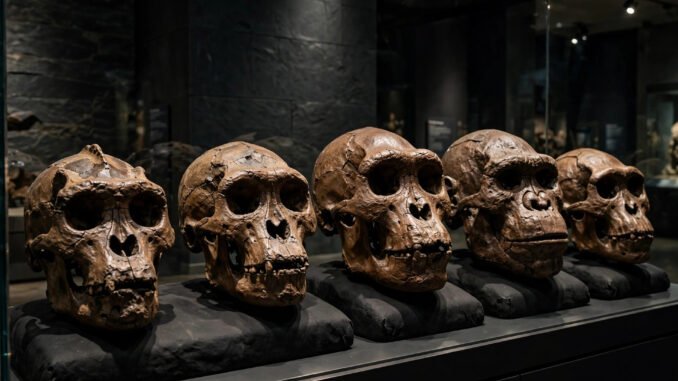
Hour 3: The evidence. Browse the Smithsonian Human Origins interactive — fossil skulls you can rotate, timelines of tool use and migration. Evidence beats argument; seeing the skulls change across millions of years is worth a hundred lectures.
Hour 4: The molecular proof. Learn the single most convincing fact in all of biology: humans share about 98.8% of our DNA with chimpanzees, and we carry dead viral fossils (endogenous retroviruses) in the same locations in our genomes — a shared inheritance no other explanation accounts for. The Human Genome Project’s public resources explain how this was established.
Hour 5: The applications. Read one article on antibiotic resistance or one on dog breeding. Watch the abstract idea snap into the concrete world.
Five hours. That’s the entire investment for a framework you’ll use for the rest of your life.
Why Some Beginners Hesitate (And Why It’s Okay)
For some readers, evolution touches religious or cultural beliefs, and that deserves respect, not dismissal. Here’s what’s worth knowing: the scientific evidence for evolution is independent of anyone’s worldview — it’s measurements, fossils, and DNA. Millions of people of faith accept evolution, including the last several Popes and the overwhelming majority of American scientists who identify as religious. Understanding the science doesn’t require abandoning your values; it just means knowing what the evidence shows. Organizations like the National Center for Science Education have decades of experience helping people navigate exactly this.
There’s also the “I’m not a science person” hesitation. Evolution is arguably the least mathematical science there is — no equations required, just careful observation and logical thinking. If you can follow a detective story (clues → pattern → conclusion), you can follow evolution.
Conclusion: The Highest-ROI Idea in Biology
So is understanding evolution in simple terms worth it for a beginner? Emphatically yes — it’s the highest return-on-investment idea in all of biology. Five hours of learning buys you a lens that clarifies medicine, food, news, and your own body for decades. The simple-terms version isn’t a watered-down consolation prize; it’s the actual core of the idea, the part Darwin himself would recognize. Variation, selection, inheritance — learn those three words deeply, and you’ve learned evolution. Everything else is just watching the most interesting story on Earth unfold.
Frequently Asked Questions
What is evolution in the simplest possible terms?
Living things vary; the variations that help survival get passed on. Over vast time, this process — natural selection — produces the diversity of life. Variation plus selection plus inheritance equals evolution.
Do I need to know genetics to understand evolution?
No. Darwin worked out natural selection without knowing about DNA. Genetics explains how inheritance works at the molecular level, but the logic of evolution stands on its own and was accepted decades before DNA’s structure was discovered.
Has evolution ever been directly observed?
Yes, repeatedly. Bacteria evolving antibiotic resistance, insects evolving pesticide resistance, the London Underground mosquito evolving into a distinct population, and Richard Lenski’s E. coli experiment (running since 1988, over 75,000 generations) all show evolution happening in real time.
Can you believe in God and accept evolution?
Millions do. The Catholic Church, most mainline Protestant denominations, and many Jewish and Muslim scholars find no conflict between faith and evolutionary science. The evidence describes how life diversified; questions of ultimate meaning belong to philosophy and theology.
What’s the best free resource for learning evolution?
UC Berkeley’s Understanding Evolution (evolution.berkeley.edu) is the gold standard — accurate, clear, and designed for non-specialists. The Smithsonian Human Origins site is the best companion for the fossil evidence.
Leave a Reply