
Earth has been through some truly catastrophic chapters. When scientists talk about “extinction events,” they mean periods when a huge share of all living species died out in a relatively short time. So how many extinction events have there been? The standard answer is five major mass extinctions — often called the “Big Five” — plus a debated sixth that may be happening right now.
Let’s walk through each one, what caused it, and what survived.
What Counts as a Mass Extinction?
Species go extinct all the time — that’s normal background extinction. A mass extinction is different: it’s when extinction rates spike far above normal and wipe out a large fraction of Earth’s biodiversity in a geological blink. Scientists generally reserve the term for events that eliminated a major share of marine genera or families, since the fossil record is most complete for ocean life.
The “Big Five” is a concept popularized by paleontologists Jack Sepkoski and David Raup in the 1980s, based on patterns in the marine fossil record. Each wiped out at least 70–75% of species alive at the time.
1. The Ordovician–Silurian Extinction (444 Million Years Ago)
Death toll: Around 85% of marine species.
At this point in Earth’s history, almost all life was in the oceans. A severe ice age locked up water in glaciers, sea levels plummeted, and shallow marine habitats — where most life lived — drained away. When the ice later melted, the returning waters were low in oxygen. It was a one-two punch that devastated trilobites, brachiopods, and early reef ecosystems. Life recovered, but it took millions of years.
2. The Late Devonian Extinction (372 Million Years Ago)
Death toll: Around 75% of species.
This one was more of a prolonged crisis than a single event — a series of extinction pulses stretched over millions of years. Armored fish that had dominated the seas vanished. The likely culprits: massive volcanic eruptions and the spread of the first forests, which changed the chemistry of soils and oceans in ways marine life couldn’t handle. Reef systems collapsed and took an extraordinarily long time to rebuild.
3. The Permian–Triassic Extinction (252 Million Years Ago)
Death toll: Around 90–96% of marine species and 70% of land species. This is the big one — the closest life has ever come to total annihilation.
Known as the “Great Dying,” this catastrophe was driven by colossal volcanic eruptions in what’s now Siberia. The eruptions pumped greenhouse gases into the atmosphere, triggering runaway warming, ocean acidification, and oxygen-starved seas. On land, the heat and arid conditions wiped out most forests and large animals. Recovery took roughly 10 million years — and the emptied world set the stage for the rise of the dinosaurs. For perspective on deep time and what the fossil record reveals, the Smithsonian’s coverage of prehistoric life is an excellent rabbit hole.
4. The Triassic–Jurassic Extinction (201 Million Years Ago)
Death toll: Around 70–75% of species.
Just as ecosystems had recovered from the Great Dying, massive volcanic activity — this time associated with the breakup of the supercontinent Pangaea — triggered another crisis. Large amphibians and many early reptile groups disappeared. The winners were the dinosaurs, which inherited an emptied world and went on to dominate for the next 135 million years. Every T. rex that ever lived owes its existence to this extinction clearing the field.
5. The Cretaceous–Paleogene Extinction (66 Million Years Ago)
Death toll: Around 75% of species, including all non-avian dinosaurs.
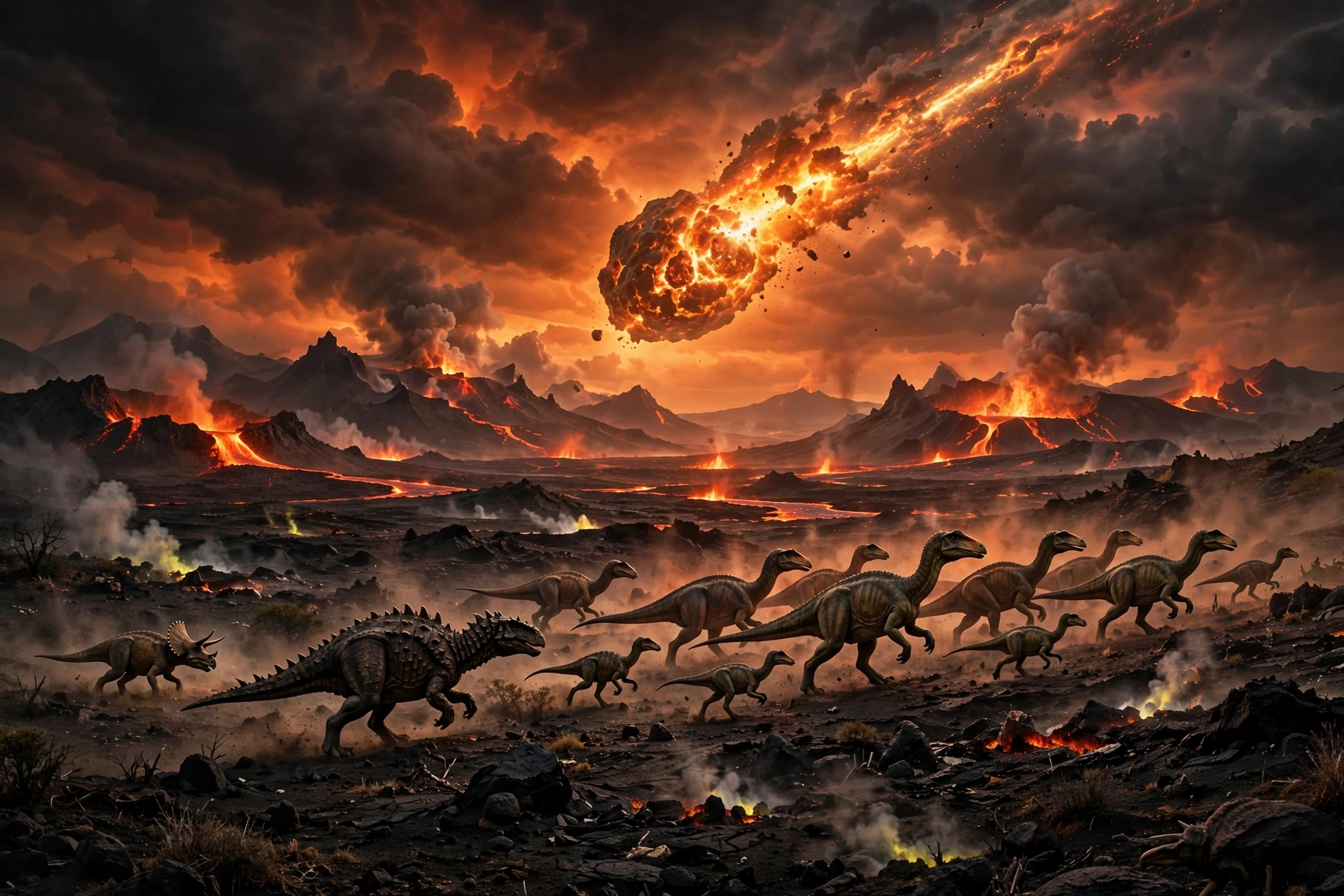
The most famous extinction, and the only one most people can name. A 6-mile-wide asteroid slammed into what’s now Mexico’s Yucatán Peninsula, releasing energy equivalent to billions of atomic bombs. Wildfires, tsunamis, and a choking cloud of dust and sulfur followed. Photosynthesis shut down for months or years. The dinosaurs — except birds, which are living dinosaurs — died out, along with giant marine reptiles and flying pterosaurs. Small mammals survived, and their descendants include us. The evidence for the impact is overwhelming, from the global iridium layer to the buried Chicxulub crater itself, as documented in the scientific record of the Cretaceous–Paleogene extinction.
Is There a Sixth Extinction Happening Now?
Many scientists argue we’re living through a sixth mass extinction — the first caused by a single species: us. Current extinction rates are estimated to be 100 to 1,000 times the natural background rate, driven by habitat destruction, climate change, pollution, and invasive species.
The debate isn’t really about whether biodiversity is crashing — it clearly is — but about whether the current crisis matches the scale and speed of the Big Five. Some researchers say yes, we’re on track. Others argue it’s too early to compare a centuries-long event with ones measured in millennia. Either way, the trajectory is alarming, and unlike the asteroid, this one is preventable.
Smaller Extinction Events Worth Knowing
Beyond the Big Five, Earth has seen numerous smaller crises:
- The Capitanian extinction (~260 million years ago) — a severe event sometimes called a “mass extinction” in its own right
- The end-Ediacaran extinction (~541 million years ago) — wiped out Earth’s first complex multicellular life
- The Pleistocene megafauna extinctions (~10,000–50,000 years ago) — mammoths, saber-toothed cats, and giant ground sloths vanished, likely with human help
What Survives Mass Extinctions?
The pattern is remarkably consistent: small, adaptable generalists survive while large specialists die. After the asteroid, it wasn’t the mighty dinosaurs that made it — it was small feathered birds and shrew-like mammals. After the Great Dying, the survivors were hardy, fast-reproducing species. There’s a humbling lesson in that for the species currently reshaping the planet.
If deep-time science fascinates you, you might also enjoy our look at how much DNA half siblings share — genetics is another field where the numbers tell surprising stories.
The Bottom Line
Five major mass extinctions have reshaped life on Earth — the Ordovician, Devonian, Permian, Triassic, and Cretaceous events — each killing 70% or more of species alive at the time. A possible sixth, driven by human activity, may be underway now. Life always recovers, but recovery takes millions of years — a timescale that should make us think carefully about what we’re doing to the only living planet we know.
The Science of Measuring Extinctions
How do scientists know these events happened — and how bad they were? The overview of mass extinction events rests on the fossil record: by counting marine genera in rock layers above and below boundary lines, paleontologists can measure exactly how much biodiversity vanished. Key evidence includes the iridium anomaly (rare on Earth, common in asteroids) marking the dinosaur-killing impact, shocked quartz from explosive force, and soot layers from global wildfires. It’s forensic science on a planetary scale, and the case for each of the Big Five is built on multiple independent lines of evidence converging on the same story.
Could It Happen Again?
Yes — and the candidates are worth knowing about:
- Asteroid impact: NASA tracks near-Earth objects, and while no civilization-killer is on a collision course, smaller impacts remain a real (if unlikely) threat. Planetary defense is now a funded scientific discipline.
- Supervolcano: Eruptions on the scale of Toba (~74,000 years ago) could trigger volcanic winter. Yellowstone gets the headlines, but the risk in any human lifetime is tiny.
- Gamma-ray burst: A nearby stellar explosion could strip the ozone layer. Astronomically rare, but it may have caused the Ordovician extinction.
- Runaway climate change: The Permian extinction’s kill mechanism — rapid greenhouse warming — is the one most relevant to today, and the only one we control.
The reassuring part: humanity is the first species capable of seeing these threats coming and potentially deflecting them. The dinosaur-killing asteroid hit a planet with no space program. We have one.
Why Extinctions Matter for Understanding Life
Mass extinctions aren’t just disasters — they’re the editing process of evolution. Each one wiped the slate and let new groups radiate into emptied ecosystems. Mammals owe their existence to the asteroid; dinosaurs owed theirs to the Triassic crisis. Without extinction, life would be less diverse, not more — the empty niches left by the dead are what the living evolve to fill. It’s a sobering but strangely hopeful pattern: destruction on a geological scale has repeatedly been the precondition for life’s greatest creative bursts.
Leave a Reply