
You’ve bought the tank, the filter, the gravel, the little plastic treasure chest — and the pet store employee said you can add fish right away. Do not do this. Understanding fish tank cycling is the single most important thing a beginner aquarist can learn, because an uncycled tank is the #1 killer of new pet fish, responsible for more beginner fish deaths than all other causes combined. The good news: cycling takes 2–6 weeks of mostly waiting, costs nothing extra, and once you understand it, you’ll never lose fish to “new tank syndrome” again. Here’s the complete beginner’s explanation.
What “Cycling” Actually Means: The Nitrogen Cycle
Fish produce ammonia constantly — through their gills, urine, and waste. Ammonia is lethally toxic to fish even at low concentrations. In nature, vast water volumes dilute it; in your 20-gallon tank, it accumulates fast. “Cycling” means establishing a colony of beneficial bacteria in your filter and substrate that converts ammonia through a two-step detoxification chain:
Step 1: Nitrosomonas bacteria convert ammonia → nitrite (still toxic, but less so).
Step 2: Nitrobacter/Nitrospira bacteria convert nitrite → nitrate (tolerable at low levels, removed by water changes and plants).
A “cycled” tank is simply a tank where these bacterial colonies are established and sized to the waste load — converting ammonia to nitrate as fast as the fish produce it. An uncycled tank has no bacteria; ammonia spikes; fish suffer ammonia burns on their gills, become lethargic, gasp at the surface, and die within days. This is “new tank syndrome,” and it’s entirely preventable.
The bacteria live primarily in your filter media (sponges, ceramic rings) — not in the water itself. This is why you never replace all filter media at once, never rinse it in tap water (chlorine kills the bacteria — rinse in old tank water), and why “just changing all the water” doesn’t crash a cycle but replacing the filter does.
The Fishless Cycle: The Right Way (2–6 Weeks)
Fishless cycling establishes the bacteria before any fish arrive, using an artificial ammonia source. No fish suffer, no emergency water changes, no guilt. Here’s the method:
1. Set up the complete tank. Substrate, filter running, heater at target temperature (bacteria colonize faster in warmth, 78–82°F), dechlorinated water, decorations. Run everything as if fish were present.
2. Add ammonia. Pure ammonia (no surfactants/fragrance — the “shake test”: if it foams, it’s wrong) dosed to 2–4 ppm, or a commercial ammonium chloride product made for cycling (Dr. Tim’s is the standard). Alternatively, fish food left to rot works but is messier and harder to dose.
3. Add bacteria (optional but recommended). Bottled beneficial bacteria (Tetra SafeStart, Dr. Tim’s One and Only, Fritz TurboStart) seeds the colony and can cut cycling time significantly. It’s the closest thing to a shortcut that actually works.
4. Test daily. You need a liquid test kit (the API Freshwater Master Test Kit, ~$25 — the single best purchase a beginner can make; test strips are unreliable). Watch the sequence: ammonia rises, then falls as nitrite rises; nitrite falls as nitrate rises. This sequence is the cycle establishing.
5. The finish line: dose ammonia to 2 ppm; 24 hours later, ammonia and nitrite both read zero with nitrate present. The tank processes a full day’s waste overnight — it’s cycled. Do a large water change to reduce nitrates, then add fish gradually (a few at a time over weeks — the bacteria colony needs to grow with each addition).
Timeline: 2–4 weeks with bottled bacteria and warmth; 4–8 weeks without. Patience is the entire skill.
Fish-In Cycling: The Emergency Method (If Fish Are Already There)
If you already added fish to an uncycled tank (the pet store’s fault, not yours), you can still save them with a fish-in cycle — it’s more work and mildly stressful for the fish, but it works:
Test water daily. Ammonia or nitrite above 0.25 ppm triggers an immediate 25–50% water change with dechlorinated water matched to tank temperature.
Dose Prime or similar daily. Seachem Prime detoxifies ammonia/nitrite for ~24–48 hours (it doesn’t remove them — it converts them to less toxic forms while bacteria catch up). This is your safety net between water changes.
Feed sparingly. Less food = less waste = less ammonia. Hungry fish survive; poisoned fish don’t.
Add bottled bacteria immediately. Every day counts.
Expect 3–6 weeks of daily testing and frequent water changes. It’s laborious — which is why fishless cycling is so strongly recommended. The fish-in cycle is damage control, not a plan.
Beginner Mistakes That Crash or Stall Cycles
Replacing filter media. The #1 cycle-killer. Those “replace monthly” instructions on filter cartridges exist to sell cartridges. Rinse media gently in old tank water when flow slows; replace only when physically falling apart — and never all at once.
Adding too many fish at once. The bacteria colony is sized to the current waste load. Doubling the fish overnight doubles ammonia production before bacteria can multiply (they double roughly every 15–24 hours under good conditions). Stock gradually.
Chlorinated water changes. Always dechlorinate. Chlorine/chloramine kills beneficial bacteria on contact — one untreated water change can nuke a cycle.
Cleaning everything at once. Deep-cleaning the filter, gravel-vacuuming the entire substrate, and scrubbing decorations in the same week removes too much bacteria at once. Stagger maintenance.
Trusting test strips. They’re notoriously inaccurate for ammonia. The liquid kit costs more upfront and saves fish lives — the math is obvious.
Antibiotics and medications. Some fish medications kill beneficial bacteria. If you must medicate, use a separate hospital tank when possible.
Plants: The Beginner’s Secret Weapon
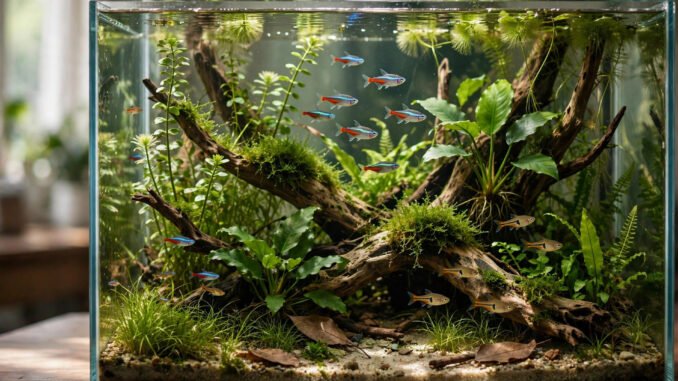
Live plants consume ammonia, nitrite, and nitrate directly — they’re a parallel filtration system that also oxygenates water and gives fish cover. Fast-growing beginner plants (anubias, java fern, hornwort, amazon sword) are nearly indestructible and significantly stabilize new tanks. A planted tank cycles more forgivingly and stays healthier long-term. If fish qualify among low-maintenance pets for apartment living — and they do, once cycled — plants are a big part of why.
And a practical home note: tanks spill, splash, and occasionally leak. Flooring options for homes with pets covers water-resistant choices worth considering before placing a 200-pound water box on your living room floor.
Ongoing Maintenance After the Cycle
A cycled tank isn’t maintenance-free — it’s maintenance-light. Weekly: test water (ammonia/nitrite should always be zero), 20–30% water change with dechlorinated water, gravel-vacuum visible waste. Monthly: rinse filter media in old tank water, trim plants, check heater and filter function. That’s it — roughly 30 minutes a week for a stable, healthy aquarium that can run for years.
The Spruce Pets’ nitrogen cycle explainer and PetMD’s fish care resources corroborate this method — fishless cycling with ammonia dosing and liquid testing is the professional consensus.
Conclusion
Understanding fish tank cycling as a complete beginner comes down to one concept: you’re not preparing water, you’re growing an invisible bacterial workforce that detoxifies fish waste. Set up the tank, add ammonia (not fish), test daily with a liquid kit, and wait 2–6 weeks until 2 ppm of ammonia clears to zero in 24 hours. Then stock gradually, never replace all filter media at once, and always dechlorinate. It’s the least glamorous part of fishkeeping and the most important — the difference between a tank where fish mysteriously die in week two and one that thrives for years. Cycle first, fish second, and you’ll skip the heartbreak that ends most beginners’ aquarium journeys before they start.
Frequently Asked Questions
How long does it take to cycle a fish tank?
Typically 2–6 weeks for a fishless cycle (faster with bottled bacteria and warm water), or 4–8 weeks without bacterial seeding. The tank is cycled when dosed ammonia (2 ppm) converts fully to nitrate within 24 hours with zero ammonia and nitrite remaining.
Can I add fish right away if I use water conditioner?
No — water conditioner removes chlorine but doesn’t establish beneficial bacteria. Adding fish to an uncycled tank exposes them to toxic ammonia spikes (“new tank syndrome”). Cycle fishless first, or commit to the labor-intensive fish-in cycling method with daily testing.
Do I need a test kit to cycle a tank?
Essentially yes. A liquid test kit (like the API Freshwater Master Test Kit, ~$25) is the only reliable way to track ammonia, nitrite, and nitrate through the cycle. Test strips are too inaccurate for this purpose. It’s the most important purchase in the hobby.
Will live plants cycle my tank faster?
They help significantly — fast-growing plants consume ammonia, nitrite, and nitrate directly, acting as parallel filtration. A planted tank is more forgiving during cycling and more stable afterward. They don’t replace the bacterial cycle, but they make everything easier.
How often should I change water in a cycled tank?
About 20–30% weekly, using dechlorinated water matched to tank temperature. This removes accumulated nitrates (the end product of the cycle) and replenishes minerals. In a cycled tank, ammonia and nitrite should always test at zero.
Leave a Reply