
If you’re new to driving or car ownership, tire pressure probably sits somewhere on your mental list between “things I should know” and “things I’ll figure out later.” It sounds technical, it sounds boring, and the little warning light on your dashboard seems to handle it for you. So here’s the direct answer: yes, understanding tire pressure is genuinely worth it — and it’s one of the highest-payoff, lowest-effort car skills a beginner can learn. Five minutes, once a month, saves you real money and makes your car meaningfully safer.
This isn’t about becoming a mechanic. It’s about knowing one number, checking it occasionally, and understanding why it matters. Here’s everything a beginner actually needs.
What Tire Pressure Actually Means (Without the Jargon)
Tire pressure is simply how much air is inside your tires, measured in PSI (pounds per square inch). Every car has a recommended pressure set by the manufacturer — usually somewhere between 30 and 35 PSI for passenger cars — and that number is printed on a sticker inside the driver’s door jamb (sometimes on the fuel door or in the owner’s manual).
Here’s the detail most beginners miss: the number molded into the tire’s sidewall is the maximum pressure the tire can handle, not the pressure you should use. Inflating to the sidewall number is a classic beginner mistake. Always use the door-jamb number for your specific vehicle.
Why does the manufacturer care so much? Because that pressure determines how much of the tire’s tread actually touches the road — the “contact patch.” Too little air and the tire’s edges carry the load; too much and only the center touches. Either way, you’re giving up grip, wearing the tire unevenly, and changing how the car handles in an emergency.
The Real Cost of Getting It Wrong
This is where the “is it worth it” question gets its answer. Underinflated tires cost you money in three separate ways, and the numbers are bigger than most people expect.
Fuel economy
Soft tires deform more as they roll, which increases rolling resistance — your engine literally works harder to push the car forward. The U.S. Department of Energy estimates that you lose about 0.2% in fuel economy for every 1 PSI your tires are below the recommended pressure, and the National Highway Traffic Safety Administration (NHTSA) notes that properly inflated tires can improve gas mileage by roughly 3%. On a car driven 12,000 miles a year, that’s easily $50–$100 annually in wasted fuel — for a problem that takes five minutes to fix.
Tire life
Underinflation is one of the top causes of premature tire wear. Tires running 20% below recommended pressure can lose a significant chunk of their tread life, and severe underinflation can destroy a tire outright through heat buildup. A new set of tires costs $400–$1,000+. Checking pressure is free.
Safety
NHTSA has consistently found that underinflated tires dramatically increase blowout risk — a tire running significantly low can overheat and fail at highway speed. Underinflation also lengthens braking distances and makes the car handle worse in emergency maneuvers. This is the part that matters more than money: correct pressure keeps the car doing what you expect it to do when something goes wrong.
For a complete beginner, making your daily commute more enjoyable starts with the basics — and a car that rolls smoothly, grips properly, and sips fuel instead of guzzling it is the foundation everything else builds on.
How to Check Tire Pressure in Five Minutes
Here’s the entire skill. You need a tire pressure gauge ($5–$15 at any auto parts store; the pencil-style ones work fine, digital ones are easier to read). That’s it.
Step 1: Check when the tires are cold. “Cold” means the car has been parked for at least three hours or driven less than a mile. Driving heats the air inside and raises the reading, so morning checks are ideal.
Step 2: Find your number. Read the driver’s door jamb sticker. It lists the recommended pressure for front and rear tires (sometimes different). Write it in your phone’s notes so you always have it.
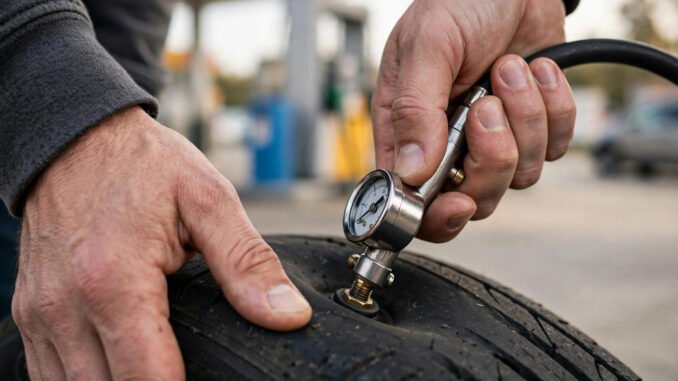
Step 3: Check each tire. Unscrew the valve cap, press the gauge firmly onto the valve stem, and read the number. Check all four tires plus the spare every few months — spares lose air too, and discovering a flat spare during a real emergency is miserable. If a highway emergency does happen, knowing how to plan a road trip across the US with proper stops includes building in tire checks at every fuel stop.
Step 4: Add or release air. Most gas stations have air pumps (often free, sometimes $1–$2). Add air in short bursts, rechecking as you go. If you overshoot, press the little pin in the valve stem to let some out. That’s the whole procedure.
The Temperature Factor Nobody Tells Beginners
Tire pressure drops about 1 PSI for every 10°F drop in outside temperature. This is why your dashboard warning light loves to appear on the first cold morning of fall — the tires didn’t develop a leak overnight; the air inside just contracted.
Practical takeaway: check pressure seasonally at minimum. When temperatures swing 30–40 degrees between seasons, your tires can easily be 3–4 PSI low without any leak at all. A quick check each time the seasons change catches this automatically.
TPMS: Helpful Dashboard Light, Not a Substitute
Since the 2007 model year, every new car sold in the U.S. has a Tire Pressure Monitoring System (TPMS) under the federal TREAD Act. It’s the dashboard light shaped like a horseshoe with an exclamation point. Useful — but it typically only warns you when pressure drops about 25% below recommended. By the time it lights up, you’ve been driving on meaningfully underinflated tires for a while.
Think of TPMS as a smoke alarm, not a thermostat. It tells you something is already wrong; it doesn’t keep things right. The monthly manual check is what keeps things right. For authoritative background, the NHTSA tire safety page covers pressure, TPMS, and tire aging in plain language, and FuelEconomy.gov from the Department of Energy quantifies the fuel savings from proper inflation.
Overinflation: The Other Mistake
Beginners who learn that low pressure is bad sometimes overcorrect. Overinflated tires ride harshly, wear out the center of the tread faster, and — counterintuitively — grip worse, because the contact patch shrinks. The door-jamb number is a target, not a minimum. Hit it and stop.
Conclusion
So, is understanding tire pressure actually worth it for a beginner? Absolutely — it’s arguably the single best time investment in basic car care. You learn one number, spend five minutes a month, and in return you get better fuel economy, longer-lasting tires, and a car that’s safer in emergencies. No mechanical aptitude required, no expensive tools, no ongoing effort. Among all the things a new driver could learn about their car, this one has the best ratio of payoff to effort by a wide margin. Learn your number, check it monthly, and drive on.
Frequently Asked Questions
How often should a beginner check tire pressure?
Once a month and before any long trip, per NHTSA guidance. Also check whenever temperatures swing significantly or the TPMS light comes on. Monthly checks catch slow leaks long before they become problems.
Should I use the number on the tire sidewall or the door jamb?
The door jamb — always. The sidewall number is the tire’s maximum safe pressure, not the recommended operating pressure for your vehicle. Using the sidewall number will overinflate your tires.
Is it safe to drive with the TPMS light on?
Drive cautiously to the nearest air pump, but don’t ignore it. The light means at least one tire is roughly 25% below recommended pressure, which affects handling and increases blowout risk. Check all four tires, not just the one that looks low — visual inspection is unreliable.
Do I need to check the spare tire too?
Yes, a few times a year. Spares lose pressure over time just like mounted tires, and a flat spare discovered during a real roadside emergency defeats the purpose of carrying one.
Can gas station air pumps damage my tires?
Not if you check with a gauge as you go. Add air in short bursts and recheck frequently. The pump itself is just compressed air — the gauge is what keeps you accurate.
Leave a Reply