
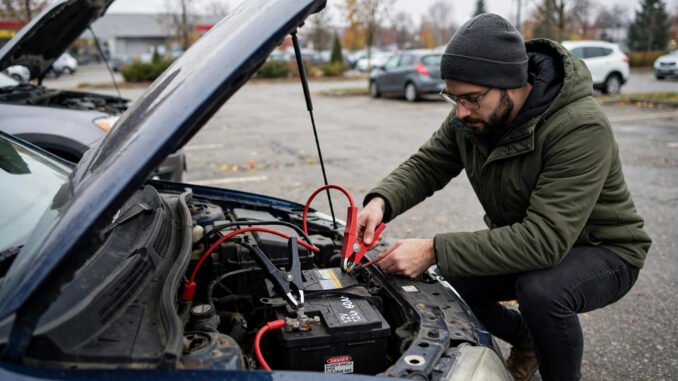
You turn the key. Click-click-click. Nothing. Your battery is dead, you are late, and a stranger is offering jumper cables with the confidence of someone who has done this before — but have you? Jump-starting a dead battery looks simple, and it is — but doing it wrong can fry your car’s electronics, damage the good battery, or in rare cases cause the battery to explode. For a beginner, the question is not just “is it worth learning” but “how do I do it without breaking something expensive?”
Yes, it is absolutely worth learning — it is a 10-minute skill that saves you a $75–$150 tow or roadside assistance call every time. This guide gives you the exact safe procedure, the mistakes that cause damage, and when not to jump-start.
What You Need (the $30 Kit)
Jumper cables ($20–$30). Get 20-foot, 4-gauge or 6-gauge cables — longer and thicker is better (cheap thin cables cannot carry enough current for larger engines). Keep them in your trunk permanently; the time to buy cables is not during the emergency.
Or: a portable jump starter ($60–$100). A lithium battery pack that jump-starts your car with no second vehicle needed. This is the modern beginner-friendly option — no cable-order memorization under stress, no stranger required, works in empty parking lots at midnight. Charge it every 3–6 months. If you buy one car-emergency item, make it this.
A second vehicle (for cable method) — any car with a charged 12V battery. Both cars should be off before you begin.
The Safe Jump-Start Procedure (Cable Method)
Memorize this order — it exists to prevent sparks near the battery (hydrogen gas) and electrical damage:
Step 1: Position the cars. Park the working car close enough for cables to reach both batteries, without the cars touching. Turn off both vehicles, all lights, and accessories.
Step 2: Identify the terminals. Red = positive (+), black = negative (−). If terminals are corroded (white/green crust), scrape them clean with a wire brush or even a key — poor contact is the number one reason jump-starts “do not work.”
Step 3: Connect RED to the DEAD battery’s positive terminal (+).
Step 4: Connect the other RED to the GOOD battery’s positive terminal (+).
Step 5: Connect BLACK to the GOOD battery’s negative terminal (−).
Step 6: Connect the other BLACK to unpainted metal on the DEAD car’s engine block — a bolt, a bracket, away from the battery. This is the grounding step that prevents sparks at the battery itself. This is the step beginners get wrong — do not connect black-to-black on the dead battery.
Step 7: Start the working car, let it run 2–3 minutes.
Step 8: Start the dead car. If it does not start within 10 seconds of cranking, stop — wait two minutes and try once more. Repeated cranking overheats the starter.
Step 9: Remove cables in REVERSE order: black from engine block, black from good battery, red from good battery, red from dead battery.
Step 10: Keep the jumped car running for 20–30 minutes (drive it, do not just idle — the alternator charges better under load) to recharge the battery.
The Mistakes That Cause Real Damage
Reversed polarity. Connecting positive to negative creates a dead short — sparks, melted cables, fried electronics, potentially thousands in damage. Double-check every connection before starting either car. Red-to-red first is the mantra.
Jumping a damaged battery. If the battery case is cracked, leaking, swollen, or smells strongly of sulfur (rotten eggs), do NOT jump it — call for a replacement. Damaged batteries can explode when jump-started. Visual inspection takes 10 seconds and prevents the worst-case scenario.
Jumping in the wrong situations. If the car cranks strongly but will not start, the battery is fine — the problem is fuel, spark, or something else, and jumping will not help. If you smell fuel strongly, do not create sparks near the engine. If the battery is frozen (bulging case in winter), do not jump it.
Modern electronics caution. Cars from roughly 2015+ have sensitive electronics; voltage spikes from improper jumping can damage modules costing $500–$2,000. This is another argument for the portable jump starter — they include spike protection that cables do not. Signs your phone has been hacked is a different kind of diagnostic, but the principle is the same: modern electronics need careful handling.
After the Jump: What Comes Next
A jump-start is a rescue, not a repair. Your battery died for a reason — find it:
Test the battery. Most auto parts stores test batteries free. Batteries last 3–5 years; if yours is in that window, the jump was a warning, not a fluke. A new battery costs $120–$250 installed — cheap insurance against the next dead morning.
Check for parasitic drain. Left a light on? That is the easy answer. If not, something may be draining the battery overnight (trunk light stuck on, aftermarket electronics) — a mechanic can test for this in 30 minutes.
Check the alternator. If the battery dies again within days despite driving, the alternator may not be charging it. Warning signs: dimming headlights, electrical gremlins, the battery warning light. Alternator replacement runs $400–$800.
Build the broader safety net too: a family emergency plan should include roadside scenarios, and DIY fixes like a leaky faucet build the same self-reliance muscle — the confidence that you can handle small emergencies yourself.
The AAA’s battery resources cover testing and replacement guidance, and Consumer Reports’ car battery buying guide rates current models if yours tests weak.
Conclusion
Jump-starting a dead battery is absolutely worth learning: a 10-minute skill, a $30 cable set (or $80 jump pack), and the confidence to handle one of driving’s most common emergencies. Memorize the connection order (red-dead, red-good, black-good, black-metal), never jump a visibly damaged battery, and treat every jump as a warning to diagnose the underlying cause. Do it right and it is routine; do it wrong and it is expensive. Now you know the difference.
Frequently Asked Questions
Can jump-starting damage my car?
Done correctly, no. Done with reversed polarity or on a damaged battery, yes — potentially thousands in fried electronics. The procedure above prevents every common damage scenario. When in doubt, use a portable jump starter with built-in protections.
How long do I need to drive after a jump-start?
20–30 minutes of actual driving (not idling) to meaningfully recharge. Short trips after a jump often lead to another dead battery the next morning — the alternator needs sustained driving to replenish the charge.
Can I jump-start a car in the rain?
Yes — rain does not create meaningful risk for 12V systems. Just keep cable connections as dry as practical and avoid standing in deep puddles while handling cables. The procedure is identical.
Why will my car not jump-start?
Common causes: poor cable connections (corroded terminals), cables too thin for the engine, the “good” battery also being weak, or the problem not being the battery at all (starter, alternator, fuel/spark issues). If two attempts fail, stop and call for help rather than risk damage.
Are portable jump starters better than cables?
For beginners, yes — no second car needed, no connection-order stress under pressure, built-in safety protections, and they double as phone chargers. The only maintenance: recharge every 3–6 months. Keep cables as backup; carry the pack as primary.
Leave a Reply