
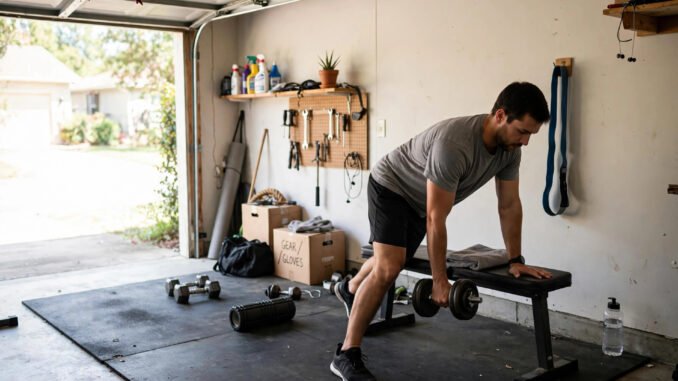
You do not need an $800 home gym to start lifting. You need weight that can get heavier over time, a floor you can use safely, and a plan you will actually follow twice a week. In Seattle, that need is met in two cheap forms: a used set of adjustable dumbbells at home, or a low-cost gym membership. Both work. The right choice depends less on price than on your space, your schedule, and your honest answer to one question: will you go?
Keep the budget in view from the start. A total of $100 to $150 is enough to begin well. One personal training session, at a typical $60 to $100, can cost more than months of either route below. Training can be useful later. It is not the entry ticket. What you need first is regular practice with a few basic movements, light weight, and good form.
Option A: Adjustable dumbbells at home
A pair of adjustable dumbbells gives you the most training for the least travel. Spin-lock handles with plates, or older dial-adjustable sets, show up often on the used market. Expect roughly $60 to $120 used for a set that covers beginner needs. Second-hand asking prices at resale sports shops often land around $0.75 to $1 per pound, framed here as a typical range, so check current listings before you drive across town. A set that reaches about 50 pounds per hand will carry most beginners for a long while.
The strengths are clear. There is no trip, no queue, and no closing time. You can train early, late, or in two short parts if the day falls apart. You can also learn in private, which matters more than people admit. Many beginners practise better when nobody is watching. For learning more about the tool itself, dumbbells and how they are used covers the main types and grips.
The limits are just as clear. You are your own coach, so you must learn form from careful sources and film yourself now and then to check it. The weight ceiling arrives in a year or two if you train steadily, because legs in particular get strong fast. You also need floor space you can protect, and a little care if you have downstairs neighbours. Dropping heavy metal at 6 a.m. is a quick way to end a home gym.
Buy with a checklist. Spin the collars and check they hold tight. Look for bent handles, cracked plates, and missing pairs. Add up the total weight yourself rather than trusting a listing headline. Bring cash, gloves for loading the car, and a second person if the set is heavy. Used dumbbells are famously hard to damage beyond use, which is why this route is such good value.
Option B: The budget gym
The gym route trades a small monthly fee for variety and heavier weight. Start by correcting the famous price in your head. The $10 membership many people still quote is legacy pricing. For new members, Planet Fitness Classic starts at $15 a month, with an annual fee of about $49. Other Seattle budget options vary, roughly $15 to $30 a month. Always check current pricing, start-up fees, and contract terms before you sign, because the headline monthly price is rarely the whole cost.
In return, you get dumbbells that commonly run up to 60 to 75 pounds, plus machines that are forgiving for beginners. A leg press, a chest press machine, and a cable row let you train hard while the path of movement is guided for you. That guidance helps while your balance and form are still new. You also get mirrors, space to carry weights, and a building where training is the only job.
The costs are time and friction. Peak hours can be crowded, with the most popular equipment taken. The trip itself, short as it is, will be the reason some sessions never happen. Contracts need reading. Ask what happens if you move, how you cancel, and when the annual fee lands. A cheap membership you understand beats a cheap membership that surprises you in month two.
If you visit a gym before joining, go at the hour you would actually train. A quiet tour at noon tells you nothing about a packed floor at 5:30 p.m. Check that the dumbbell area has space to step back for Romanian deadlifts, that staff can show you how to adjust machines, and that the walk, bus ride, or parking routine feels easy enough to repeat in February rain.
The programme: whichever route you choose
The equipment matters less than the programme, and the beginner programme is short on purpose. Train the whole body 2 to 3 times a week, with at least one rest day between sessions. Each session takes about 40 minutes. Use 6 to 8 fundamental movements and repeat them until they feel solid. Novelty is not the goal. Competence is.
Here is the session. Goblet squat, 3 sets of 8 to 10 reps. Romanian deadlift, 3 sets of 10. One-arm row, 3 sets of 10 on each side. Floor press, 3 sets of 8 to 10. Overhead press, 2 sets of 8. Finish with a carry, holding a weight in each hand and walking for a short distance, or a plank held for steady breathing. Rest long enough between sets that your form stays clean, often one to two minutes.
Progress in the smallest step you have. When the top reps of a set feel controlled and you could have done one or two more with good form, add a little weight next time. Small plates, a slower lowering phase, or one extra rep are all honest progress. For the science behind why this steady loading works, strength training and how it adapts the body explains the basic response in plain terms.
Warm up with five minutes of easy movement and one light set of the first exercise. Keep a simple log on your phone or on paper: date, exercise, weight, reps. Without a log, you will guess, and guessing usually means repeating the same weight for months or jumping too fast after a good day. The log is the cheapest coach you will ever have.
Safety rules for the uncoached beginner
These rules are not decoration. Learn form with light weights first, even if the weight feels embarrassingly easy in week one. You are teaching joints and balance a new skill. Heavy weight on a new skill is how beginners get hurt.
Never test a maximum alone. There is no prize for finding your one-rep limit in an empty garage or a quiet gym corner. Train in ranges you can control, and leave one or two good reps in reserve on most sets. If you train at home by yourself, choose dumbbells before barbells for solo training. Dumbbells can be set down or dropped clear of your body far more easily than a loaded bar across your chest or back.
Learn the difference between effort and warning. Muscles that burn, shake a little, and feel tired the next day are normal parts of training. Sharp pain is a stop signal, not soreness. Stop the set. Do not push through it to finish a number in a plan. Ease off, and get persistent pain checked by a qualified professional. The same rule applies to joint pain, numbness, or pain that changes how you move. A week of caution is cheap. An injury that stops you for two months is not.
Set up each lift before you start it. For floor press, keep your upper arms supported by the floor and your wrists straight. For rows, brace your free hand and keep your back flat. For carries, pick the weights up with your legs, stand tall, and walk a clear path. Most beginner accidents are not dramatic. They are rushed set-ups, cluttered floors, and one more rep attempted after form has already fallen apart.
Two common worries deserve plain answers. First, you will not get bulky by accident. Muscle gain is slow, even when you do everything well. Beginners who fear sudden size can relax: you will get stronger and a little firmer long before you get large, and you can adjust food and training if your goals change. Second, results come on two clocks. Strength gains often show in weeks, as your body learns the movements. Visible change typically takes months. Judge the first month by performance and habit, not by the mirror.
Recommendation: pick the route you will repeat
Choose home dumbbells if the trip would kill the habit. If your days are packed, your nearest gym is awkward to reach, or you know you train best in private, the used set wins. It removes every excuse except the work itself, and it pays for itself in a few months compared with a membership.
Choose the gym if you want machine variety and heavier weights soon, if home space is tight, or if leaving the house helps you switch into training mode. Many people focus better in a place built for one purpose. If that is you, the monthly fee is not waste. It is rent for focus.
Cardio does not need its own expensive answer. Walking plus lifting covers most beginners well. Walk on rest days, take the hills Seattle gives you for free, and let the lifting build strength. Add harder cardio later only if you enjoy it or a specific goal asks for it.
If your budget is zero right now, start anyway with your own bodyweight while you save or watch the used listings. Squats to a chair, push-ups against a counter, and rows under a sturdy table build the habit and some real strength. The guide to strength training without weights shows how to begin with nothing at all. The best starter programme is the safe one you repeat for the next twelve weeks, not the perfect one you admire for twelve minutes.
Leave a Reply