
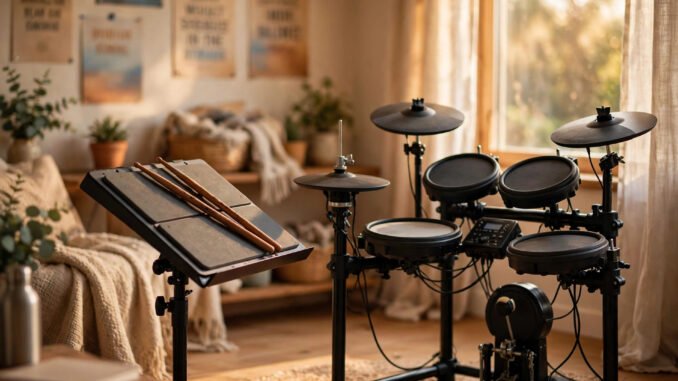
Every drummer starts the same way: tapping on tables, steering wheels, and unfortunate coworkers’ shoulders. Turning that instinct into actual drumming feels like it should cost a fortune — drum kits are big, loud, and famously expensive. But the real cost of learning drums as a beginner in Columbus, Ohio is one of music’s best-kept secrets: you can start for less than a nice dinner out, and even the full “real kit in the garage” path costs far less than most people assume. Here’s the honest price breakdown, the cheapest legitimate starting path, and where Columbus specifically makes it easier.
The Real Cost Breakdown
Let’s put numbers on every tier. Tier 1 — the true start ($30–$50): a practice pad ($20–$30) and a pair of sticks ($10–$15). This is not a compromise; it’s how most teachers start beginners anyway, because the first months are about stick technique and rudiments, not kits. Tier 2 — the electric path ($250–$500): a beginner electronic kit (Alesis or Donner, $250–$350 new, often under $200 used) plus headphones. Electronic kits are the apartment-dweller’s miracle: real drumming motion at conversation volume. Tier 3 — the acoustic kit ($150–$800): a used acoustic kit on Columbus’s Facebook Marketplace or Craigslist runs $150–$300 for a playable beginner set; new beginner kits (Pearl Roadshow, Ludwig Breakbeats) run $400–$500. Lessons ($100–$200/month): private instruction in Columbus typically costs $25–$50 per half hour weekly. That’s the full menu — and notice the entry point is fifty bucks, not five hundred.
The $100 Starter Path That Actually Works
Here’s the no-waste sequence teachers recommend. Month 1–2: practice pad, sticks, and free online lessons. YouTube’s free drum education is genuinely excellent — Drumeo’s free content, Stephen Taylor’s lessons, and countless rudiment tutorials cover grip, the basic stroke types, and the first rudiments (single strokes, double strokes, paradiddles). Your only job is building clean, even strokes. Month 3: add a metronome app (free) and start playing along to simple songs on the pad — coordination before kit. Month 4+: now consider a kit, and consider used first. Columbus’s used market is active — college turnover at Ohio State keeps beginner kits circulating — and a $200 used kit with new heads ($50–$80 for a full set of Remo or Evans heads) plays better than a $400 kit with dead factory heads. The single biggest beginner waste is buying a full acoustic kit in week one and discovering in month two that drumming is mostly practicing one hand pattern for an hour. Earn the kit with the pad.
Where to Learn in Columbus (Beyond YouTube)
Columbus punches above its weight for beginner drummers. Music stores: Guitar Center at Easton and the various Music & Arts locations sell sticks, pads, and heads at standard prices and — more valuably — let you try practice pads and sit at display kits. The staff drum conversations alone are free education. School of Rock and similar performance-based schools have Columbus-area locations with group programs that put beginners on stage fast; pricier than YouTube but unmatched for motivation. The library: the Columbus Metropolitan Library stocks drum method books (the classics: Stick Control for technique, Syncopation for reading) that cost $15–$25 new — or free with your card. Community: Columbus has an active open-mic and blues jam scene where beginner-friendly jams welcome new players; showing up with sticks and humility teaches timing faster than any app. Check School of Rock’s free online resources for structured beginner paths, and browse Sweetwater’s buying guides when you’re ready to compare kits — their guides are written by working musicians, not copywriters.
Rent vs. Buy: The Math
Rental is the underused middle path. School band instrument programs and some Columbus music stores rent drum kits and snare kits for roughly $25–$45/month, often with rent-to-own credit. The math favors renting when: you’re unsure the interest will last (three months of rental is cheaper than a kit gathering dust), you need an acoustic kit for a school band season, or you want to try acoustic before committing. Buying wins when: you’ve practiced three months on a pad and still show up daily (the interest is real), you find a good used deal, or you go electronic (rental programs rarely cover e-kits well). One more cost people forget: heads and sticks are consumables. Budget $50–$80/year for heads and $30–$60/year for sticks once you’re playing regularly. It’s the strings-and-reeds equivalent — every instrument has a consumable tax, and drums’ is modest.
Protect Your Hearing From Day One
This is the section beginners skip and veterans wish they hadn’t. Acoustic drums routinely hit 100–120 decibels — a snare crack is literally as loud as a chainsaw. Hearing damage is cumulative and permanent. Foam earplugs ($5) cut 20+ decibels and are infinitely better than nothing; musician’s earplugs ($15–$40, Etymotic or similar) cut volume evenly so music still sounds right. Electronic kits with headphones solve it structurally — another quiet point in their favor. Make hearing protection part of the starter kit, not an afterthought, and read up on protecting your hearing at loud concerts and events — the same physics applies to the audience and the stage. While you’re building the musician’s lifestyle, discovering new music beyond the same popular songs gives your practice sessions an endless supply of grooves to steal — every drummer is a curated playlist of other drummers.
So how much does learning drums as a beginner really cost in Columbus? Fifty dollars to start properly, $250–$500 for a real kit when you’ve earned it, $100–$200 a month if you add lessons. The city gives you stores to try gear, a library full of method books, a used market fed by OSU turnover, and jam nights to aim for. The expensive version of this hobby is buying everything upfront; the smart version is a pad, sticks, free lessons, and patience. The beat, as they say, goes on — affordably.
Frequently Asked Questions
Can I really start drums with just a practice pad?
Yes — and most teachers prefer it. The first months of drumming are stick technique, rudiments, and timing, all of which happen on a pad. Starting on a full kit often just means practicing pad exercises on an expensive surface while annoying the household.
Electronic or acoustic kit for a beginner?
Electronic if volume matters (apartments, shared walls, late practice) — modern budget e-kits feel surprisingly good. Acoustic if you have the space and want the real feel and dynamics. Used acoustic kits offer the best value per dollar; new e-kits offer the best neighbor relations.
How much are drum lessons in Columbus?
Typically $25–$50 per half-hour weekly lesson at private studios and music schools, or $100–$200/month. Group programs and school-based instruction cost less. Free YouTube instruction covers the beginner fundamentals well enough to delay paid lessons for months.
Is it too late to start drums as an adult?
No. Drumming is coordination training, and adults learn coordination fine — often faster than kids, because they practice deliberately. Plenty of Columbus community jams include adult beginners. Your neighbors’ tolerance, not your age, is the binding constraint (see: electronic kits).
How loud are acoustic drums, really?
A drum kit played with normal energy produces 100–120 dB; the snare alone can exceed 120 dB at the player’s ear. That’s chainsaw territory. Always use hearing protection — foam plugs at minimum, musician’s plugs ideally.
Leave a Reply