
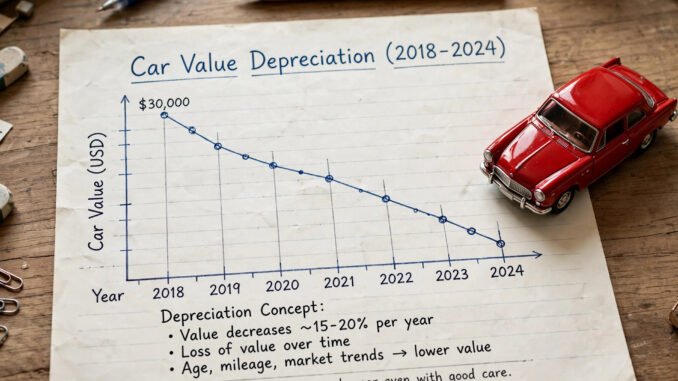
A new car loses roughly 20% of its value in the first year and about 15% per year for the next several — meaning a $40,000 car is worth around $21,000 after five years. Depreciation is the single largest cost of car ownership, bigger than fuel, insurance, and maintenance combined, yet most buyers never think about it until trade-in day delivers the shock. Understanding car depreciation will not stop your car from losing value — nothing does — but it determines whether you lose $8,000 or $20,000 over your ownership. That is a choice, and this guide shows how to make it well.
How Depreciation Actually Works
Depreciation is steepest early and flattens over time — the classic curve: Year 1: ~20% gone (the infamous “drive-off-the-lot” drop). Years 2–3: ~15% per year. Years 4–5: ~10% per year. Years 6+: ~5–8% per year as the car approaches its floor value. A $40,000 new car: ~$32,000 after year 1, ~$27,200 after year 2, ~$23,100 after year 3, ~$20,800 after year 4, ~$19,000 after year 5. These are averages — the actual curve varies enormously by brand, model, and market conditions, which is where strategy lives.
Why the first year hurts most: a new car competes with other new cars (plus incentives and warranties), while a one-year-old car competes with all used cars. The buyer of your year-old car demands a discount for forgoing the new-car warranty, the latest features, and the new-car smell — that discount is your depreciation. The Consumer Financial Protection Bureau’s auto resources explain how depreciation interacts with loan balances — the combination is what traps buyers underwater.
What Makes Some Cars Depreciate Faster
Brand and model reputation
The dominant factor. Toyota, Honda, and Lexus consistently top resale-value rankings (a 5-year-old RAV4 retaining 60%+ of MSRP); luxury flagships and niche models often retain under 40%. Reliability reputation is the mechanism — used buyers pay for expected repair costs, so reliable brands hold value. Check brand-level resale data before buying, not after.
Supply and demand dynamics
Mass-produced fleet favorites (rental-lot sedans) flood the used market and depreciate hard. Limited-production or high-demand models (Wranglers, certain trucks, enthusiast cars) hold value because used supply stays tight. EVs are the current volatility story: rapid tech improvement and tax-credit dynamics have made 3-year-old EVs depreciate faster than comparable gas cars — great for used EV buyers, painful for new EV buyers.
Fuel prices and regulation
When gas spikes, efficient cars hold value and guzzlers crater — 2008’s SUV collapse is the textbook case. Regulatory shifts (emissions rules, EV mandates in states like California) can strand certain powertrains. You cannot predict fuel prices, but you can avoid the extremes: the ultra-thirsty and the bleeding-edge.
Condition, mileage, and history
Within a model’s range, these create 10–20% value spreads: accident history (even repaired) discounts 10–15%, high mileage penalizes non-linearly past 100,000 miles, and poor cosmetic condition signals poor mechanical care to buyers. Meticulous maintenance records are the cheapest value-preservation tool in existence.
Seven Ways to Lose Less to Depreciation
1. Buy 2–3 years old. Let someone else absorb the 35–40% first-three-years drop. A 3-year-old car at 60% of MSRP with 80% of its life remaining is the depreciation sweet spot. 2. Choose high-resale brands and models. The resale rankings exist — consult them before the test drive, not at trade-in. 3. Buy popular colors. White, black, silver, and gray resell easiest; purple and lime green shrink your buyer pool and your price. 4. Keep mileage reasonable. The 12,000–15,000 miles/year norm is priced in; 25,000/year fleet-style use accelerates depreciation disproportionately. If your daily commute is long, that mileage math deserves a hard look before you buy. 5. Maintain obsessively and keep records. Dealer service records, a clean interior, and prompt cosmetic repairs return multiples at sale time. A well-organized garage is not just satisfying — garaged cars genuinely retain value better (paint, interior, and rubber all degrade slower out of the sun). 6. Avoid heavy modifications. Lift kits, custom wraps, and engine tunes shrink your buyer pool to enthusiasts who pay less, not more. Stock sells. 7. Time your sale. Convertibles sell best in spring, 4WD vehicles in fall, and tax-refund season (February–April) lifts the whole used market. Selling into seasonal demand is free money.
Depreciation vs. Your Loan: The Underwater Trap
Depreciation becomes dangerous when it outruns your loan balance — owing more than the car is worth (“underwater” or “negative equity”). The classic trap: $5,000 down on a $35,000 car with a 72-month loan at 8%. After two years you have paid mostly interest, the car has lost ~35% of its value, and you owe thousands more than it is worth — if it gets totaled, insurance pays market value and you still owe the lender the gap.
Defenses: 20% down payments (the depreciation cushion), loan terms under 60 months (principal paydown outruns value loss), and GAP insurance ($200–$300 from your insurer, not $800 from the dealer) covering the difference if disaster strikes early. NerdWallet’s auto-loan calculators let you model loan-versus-value over time — run your specific deal before signing, not after the shock.
Leasing and Depreciation: The Shortcut
Leasing is depreciation arbitrage: you pay for the value the car loses during the lease term plus interest and fees, then walk away. When manufacturers subsidize leases (inflated residual values, low money factors), leasing can cost less than the depreciation you would have absorbed buying — particularly for luxury vehicles that depreciate brutally. The math favors leasing when: you drive under 12,000 miles/year, you want a new car every 3 years anyway, and the subsidized payment beats buy-and-hold depreciation. It punishes high-mileage drivers and chronic lessees who never build equity. Neither is morally superior — it is arithmetic with lifestyle inputs.
Conclusion
Understanding car depreciation means internalizing one curve (20% year one, flattening after) and acting on it: buy 2–3 years old to skip the steepest drop, choose brands and models with proven resale, keep mileage and condition exemplary, put 20% down on loans under 60 months, and time sales to seasonal demand. Depreciation is inevitable — but the difference between the best and worst depreciation outcomes on the same budget is $10,000+. That is not luck. It is strategy, applied before you buy rather than regretted after.
Frequently Asked Questions
How much does a car depreciate per year?
Roughly 20% in year one, ~15% annually in years 2–3, ~10% in years 4–5, then 5–8% yearly. A $40,000 car is typically worth about $19,000–$21,000 after five years, varying widely by brand and model.
Which cars hold their value best?
Toyota, Honda, and Lexus consistently lead resale rankings; popular trucks and Wranglers also hold well. Luxury flagships, niche models, and fleet-heavy sedans depreciate fastest.
How do I avoid being underwater on a car loan?
Put at least 20% down, keep loan terms at 60 months or less, and consider GAP insurance ($200–$300 from your insurer). These ensure your loan balance stays below the car’s depreciating value.
Is leasing better than buying for depreciation?
Leasing lets you pay only for the depreciation during the lease term — advantageous for subsidized leases on fast-depreciating luxury cars if you drive under 12,000 miles/year. Buying wins for long-term holders and high-mileage drivers.
Does color affect a car’s resale value?
Yes. White, black, silver, and gray resell easiest with the broadest buyer pool; unusual colors (purple, bright green, orange) typically sell for less and take longer.
Leave a Reply