
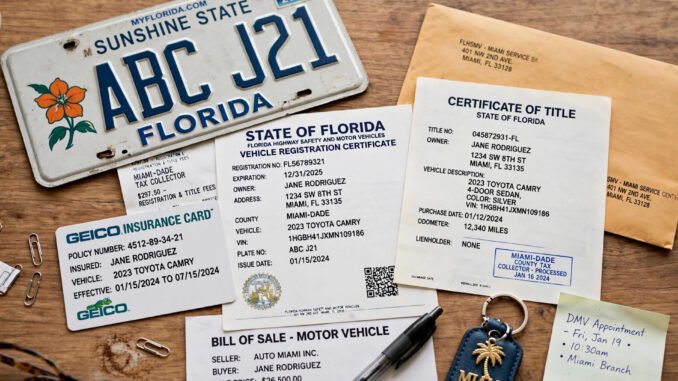
You just bought a car in Miami. Congratulations — now the state of Florida wants its paperwork and its money. Vehicle registration in Florida is refreshingly straightforward compared to many states (no annual inspections, no emissions testing), but the fees, deadlines, and title-transfer rules trip up newcomers constantly — and missing the 30-day title transfer deadline means penalties. Whether you bought from a dealer, a private seller, or just moved to Miami from another state, here is exactly what vehicle registration fees cost and how the process works.
What Registration Actually Costs in Miami-Dade (2026)
Florida’s registration fees are weight-based, not value-based — a refreshing change from states that tax your car’s worth annually:
Standard automobiles (up to 2,499 lbs): $14.50/year base. 2,500–3,499 lbs (most sedans and small SUVs): $22.50/year. 3,500+ lbs (large SUVs, trucks): $32.50/year. On top of the base fee: initial registration fee ($225 one-time for vehicles never before registered in Florida — the big one newcomers miss), plate fee (~$28 for a standard metal plate), service fees ($2.50–$7.50 depending on transaction), and Miami-Dade county fees (small local surcharges).
Realistic first-year total for a newcomer registering a sedan: $225 (initial fee) + $22.50 (registration) + $28 (plate) + ~$7 (fees) ≈ $280–$290. Renewals in subsequent years: roughly $50–$70 total. Compared to states charging hundreds annually based on vehicle value, Florida is cheap — the pain is concentrated in year one. The official fee schedules are published by the Florida Highway Safety and Motor Vehicles (FLHSMV) — always verify current numbers there before budgeting.
Scenario 1: Bought From a Florida Dealer
The easy path: the dealer handles title and registration electronically, collects the fees and sales tax, and issues a temporary tag. Your metal plate and registration arrive by mail, typically within 30 days. Verify the dealer actually submitted the paperwork — call the FLHSMV or check online if your registration has not arrived in three weeks. Dealer errors are rare but real, and driving on an expired temp tag earns tickets.
Scenario 2: Bought From a Private Seller
This is where people get burned. Florida law requires title transfer within 30 days of purchase — miss it and penalties accrue. The process:
1. Verify the title before paying. It must be a clean Florida title in the seller’s name with no liens (or lien release documentation). Never buy a car with an “open title” (signed over but not transferred) — title jumping is illegal in Florida and leaves you holding an unregisterable car. 2. Get insurance first. Florida requires proof of insurance (PIP + property damage liability minimums) before registration — no insurance, no plates. 3. Visit a tax collector’s office or authorized tag agency with: the signed-over title, bill of sale, your Florida driver’s license or ID, and proof of insurance. Miami-Dade has multiple locations plus private tag agencies (which charge a convenience fee of $10–$30 but save hours of waiting). 4. Pay the fees and taxes. Private-party sales owe the same 6% state + 1% Miami-Dade surtax on the first $5,000 as dealer sales — calculated on the purchase price (or fair market value if the stated price looks suspiciously low; the state checks).
Meet the seller at their bank if a lien exists (the bank releases the title on payoff), or at a tag agency to complete the transfer on the spot. Never hand over cash without the signed title in your hand. General federal guidance on vehicle paperwork is available at USA.gov’s vehicle registration resources.
Scenario 3: Just Moved to Miami From Another State
New Florida residents must register their vehicles within 30 days of establishing residency (starting a job, enrolling kids in school, signing a lease — any of these can trigger it). You will need: out-of-state title (or lienholder information — Florida contacts the lienholder for electronic titles), proof of Florida insurance, VIN verification (done at the tax collector’s office or by law enforcement), and your Florida driver’s license (get this first — you need it within 30 days too). Budget the $225 initial registration fee plus the standard fees above. One quirk: Florida does not require you to surrender your old plates, but most states want them back — check your former state’s rules to avoid stray toll violations.
If the move involves a long drive south, our guide to planning a US road trip with stops covers the logistics — and once you are settled and commuting, making your daily commute enjoyable becomes the next quality-of-life project.
Renewals, Deadlines, and Penalties
Florida registrations renew annually based on the owner’s birth month (or a designated month for businesses). Renew online, by mail, or in person — online is fastest. Late penalties: Delinquent renewals accrue penalties, and driving with an expired registration (over 6 months) becomes a criminal violation in Florida, not just a ticket — do not let it slide. Registration ≠ insurance: Florida aggressively suspends registrations for insurance lapses via electronic verification — a one-day gap can trigger a suspension notice and $150+ reinstatement fees. Keep coverage continuous, especially when switching insurers.
Money-Saving Tips
Renew for two years where eligible — it locks current rates and halves the hassle. Use tax collector offices strategically: smaller Miami-Dade locations and private tag agencies have shorter waits than the mega-offices; appointments booked online skip walk-in lines. Transfer plates when replacing a vehicle — transferring your existing plate ($7–$12) beats buying new ($28+) and skips the initial registration fee. Go paperless where offered to avoid replacement-document fees. And never pay a “registration service” more than the tag-agency convenience fee — storefront services charging $100+ for what a tag agency does for $30 are pure markup.
Special Cases: Leased, Gifted, and Inherited Vehicles
Leased vehicles: The leasing company holds the title; they handle registration paperwork, but you pay the fees — confirm who processes the annual renewal (usually you, online) so it does not lapse unnoticed. Gifted vehicles: Florida allows tax-exempt title transfers between certain family members with a gift affidavit — a legitimate saving worth using, but the relationship must qualify and the paperwork must be exact; tag agency staff handle these routinely. Inherited vehicles: Bring the death certificate, the will or probate documents, and the title to the tax collector’s office; the process is straightforward but document-heavy, so call ahead for the exact checklist. Out-of-state lienholders: If you still owe on a car bought elsewhere, Florida’s electronic title system contacts your lienholder directly — start this early, as lienholder response times vary and your 30-day clock is ticking.
Conclusion
Understanding vehicle registration fees in Miami comes down to: ~$280–$290 in year one (dominated by the $225 initial fee), ~$50–$70 annually after, title transfer within 30 days with insurance in hand, and continuous coverage to avoid suspension. Dealers handle their sales; private buyers must run the process themselves at a tax collector’s office or tag agency; newcomers get 30 days from establishing residency. It is one of Florida’s simpler bureaucracies — respect the deadlines and it stays that way.
Frequently Asked Questions
How much is car registration in Miami, Florida?
First-year registration for a newcomer runs ~$280–$290 (including the $225 one-time initial registration fee). Annual renewals cost roughly $50–$70 depending on vehicle weight, plus small county fees.
How long do I have to transfer a car title in Florida?
30 days from purchase. Late transfers accrue penalties, so complete the transfer at a tax collector’s office or tag agency promptly.
Do I need insurance before registering a car in Florida?
Yes — proof of Florida insurance (PIP and property damage liability minimums) is required before the state will issue registration and plates.
I just moved to Florida. When must I register my car?
Within 30 days of establishing residency (starting work, signing a lease, enrolling children in school). You will need a Florida driver’s license, VIN verification, and Florida insurance.
Does Florida require emissions testing or safety inspections?
No. Florida eliminated both — there are no annual vehicle inspections or emissions tests required for registration.
Leave a Reply