
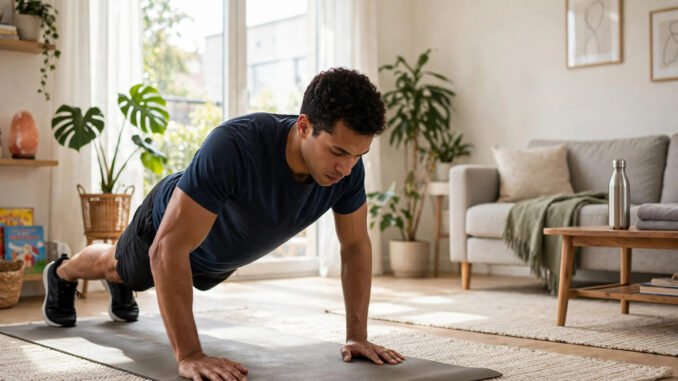
After 30, adults lose 3–8% of muscle mass per decade — a process called sarcopenia — unless they actively fight it. Strength training is the fight, and it does not require a gym, a barbell, or a single dollar. Bodyweight training — push-ups, squats, lunges, planks — builds real, functional strength using the one weight you always carry: yourself. The question is not whether it works (decades of research say it does). The question is whether you should start now — and the answer is an emphatic yes, with a few caveats about how.
Why Bodyweight Training Works (The Science)
Muscles do not know whether resistance comes from iron or bodyweight — they know tension, fatigue, and progressive overload. Studies comparing bodyweight programs to gym-based programs find comparable strength and muscle gains in beginners over 8–12 weeks, provided the bodyweight exercises are progressed (made harder over time). Push-ups build the chest, shoulders, and triceps; squats and lunges build the legs and glutes; planks and hollow holds build the core; inverted rows (under a sturdy table) build the back.
The benefits compound beyond muscle: strength training improves bone density, insulin sensitivity, balance (a major fall-prevention factor as you age), and even cognitive function. The CDC recommends muscle-strengthening activities at least twice weekly for all adults, and the National Institute on Aging specifically highlights strength training as essential for maintaining independence with age. If you are currently inactive, our guide to exercise for beginners who hate the gym covers the mindset shift that makes starting stick.
Is Now a Good Time to Start, or Should You Wait?
Start now — but start where you are, not where Instagram is. The “should I wait” instinct usually masks one of three concerns:
“I am too out of shape”
Bodyweight exercises scale infinitely. Cannot do a push-up? Do wall push-ups, then incline push-ups on a countertop, then knee push-ups, then full push-ups. Each step might take 2–4 weeks. The program meets you at the wall — literally.
“I have joint issues”
Get medical clearance for diagnosed conditions, then favor joint-friendly variations: box squats (sitting back to a chair) instead of deep squats, glute bridges instead of lunges if knees protest, dead bugs instead of crunches for cranky backs. Pain is information — muscle burn is fine, joint pain is a stop sign.
“I will start when life calms down”
Life never calms down. The minimum effective dose is two 20-minute sessions per week — less time than one streaming episode. Waiting for perfect conditions is how “someday” becomes “never.”
The Starter Program: Two Days a Week, 20 Minutes
Do this twice weekly with at least one rest day between. Rest 60–90 seconds between sets.
Bodyweight squats — 3 sets of 10–15. Feet shoulder-width, sit back like lowering into a chair, keep chest up. Too easy? Slow down: 3 seconds down, 1 second pause, 1 second up. Incline push-ups (hands on a sturdy countertop or stairs) — 3 sets of 8–12. Body in a straight line from head to heels. Glute bridges — 3 sets of 12–15. Lie on your back, feet flat, drive hips up and squeeze. Reverse lunges — 2 sets of 8 per leg. Step backward (easier on knees than forward lunges). Plank — 3 holds of 20–40 seconds. Dead bugs — 2 sets of 8 per side for deep core.
Progression is the program: when you can complete all sets and reps with good form, make it harder — deeper range, slower tempo, more reps, then harder variations (full push-ups, Bulgarian split squats with foot on a chair, single-leg glute bridges). This is progressive overload without a single plate, and it works indefinitely for the first 1–2 years. For how this fits your total activity, see how much exercise you need each week.
What Costs Money (and What Does Not)
Free and sufficient: The entire program above. A floor, a wall, a chair, a countertop. Worth $20–$40 eventually: A doorway pull-up bar (adds the crucial pulling movement bodyweight programs lack) and a set of resistance bands (cheap, portable progressive overload). Do not buy yet: Adjustable dumbbells, kettlebells, weight benches, or any program costing money. Revisit equipment after 3–6 consistent months, when you know which movements you enjoy and where bodyweight progression is stalling. The number one waste in home fitness is buying equipment for a habit that does not exist yet.
Recovery and Realistic Timelines
Expect noticeable strength gains in 4–6 weeks (mostly neurological — your brain learning to recruit muscle) and visible muscle change in 8–12 weeks. Soreness in the first two weeks is normal; it fades as your body adapts. Sleep 7–9 hours — muscle is built during recovery, not during the workout — and eat adequate protein (roughly 0.7–0.9g per pound of bodyweight daily). Train no more than 3–4 days weekly as a beginner; muscles need 48 hours between hard sessions for the same muscle group.
Your First 6 Months: A Progression Map
Here is how the program evolves so you never plateau: Months 1–2: Master the starter routine above with perfect form. Film yourself from the side on squats and push-ups once — form errors you cannot feel become obvious on video. Months 3–4: Add the pull-up bar for inverted rows (3 sets of 8) and assisted pull-up negatives; progress push-ups from incline to full, squats to Bulgarian split squats. Sessions grow to 30 minutes. Months 5–6: Introduce harder variations — archer push-ups, pistol squat progressions (assisted with a doorframe), single-leg glute bridges, and plank variations (side planks, plank shoulder taps). Add resistance bands for rows and press variations to keep overload climbing.
By month six, consistent trainees typically double or triple their starting rep counts and handle movements that looked impossible in week one. That is when equipment earns its place: a set of adjustable dumbbells or a kettlebell ($80–$150) opens new progression paths. But notice the principle — every dollar follows demonstrated consistency, never precedes it. The trainees who last are not the best equipped; they are the ones who treated progression as the program and gear as the reward.
Conclusion
Strength training without weights is not a compromise — for beginners, it is the optimal starting point: free, joint-friendly, infinitely scalable, and backed by solid evidence. Start now with two 20-minute sessions weekly, progress the movements as they get easy, add a pull-up bar and bands only after months of consistency, and give it twelve weeks. The best time to start was a decade ago. The second-best time is today, in your living room, with zero equipment.
Frequently Asked Questions
Can you build muscle with bodyweight exercises only?
Yes, especially as a beginner. Studies show comparable strength and muscle gains to gym training over 8–12 weeks when bodyweight exercises are progressively made harder (slower tempo, harder variations, more reps).
How often should beginners do bodyweight strength training?
Two to three sessions per week, 20–30 minutes each, with at least one rest day between sessions working the same muscles.
What is the best bodyweight routine for beginners?
Squats, incline push-ups, glute bridges, reverse lunges, planks, and dead bugs — covering legs, push, and core. Add a doorway pull-up bar later for pulling movements.
Do I need equipment to start strength training at home?
No. A floor, wall, chair, and countertop suffice for months. Consider a pull-up bar ($20–$40) and resistance bands only after 3–6 months of consistent training.
How long until I see results from bodyweight training?
Strength gains in 4–6 weeks, visible muscle changes in 8–12 weeks, assuming consistent training, adequate protein, and proper sleep.
Leave a Reply