
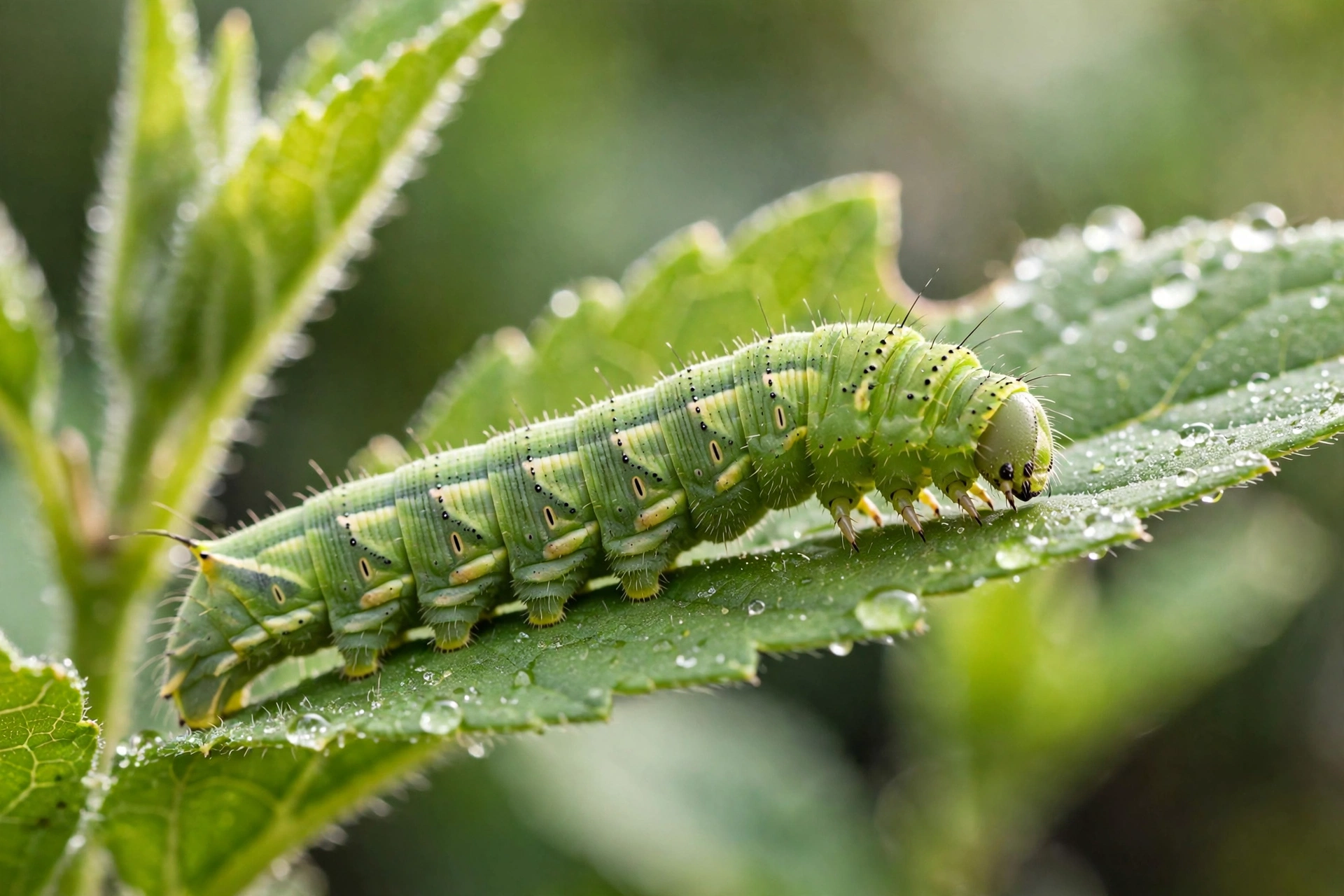
It’s one of those questions that sounds simple until you actually think about it: how many legs does a caterpillar have? If you picture a caterpillar inching along a leaf, you might guess “dozens.” The real answer is more precise — and more interesting — than most people expect.
The Short Answer: 16 Legs (Sort Of)
A caterpillar has 16 legs in total — but they’re not all the same kind of leg. Here’s the breakdown:
- 6 true legs — jointed, with claws, located on the thorax (the front segments). These are the “real” insect legs, and they’ll become the butterfly or moth’s six legs after metamorphosis.
- 10 prolegs — fleshy, unjointed stubs on the abdomen that grip surfaces with tiny hooks called crochets. These disappear during metamorphosis.
So the technically precise answer: 6 true legs + 10 prolegs = 16 total leg-like appendages. If someone asks “how many true legs,” the answer is 6 — like all insects.
True Legs vs. Prolegs: What’s the Difference?
This distinction is what makes the question great trivia:
- True legs are jointed, made of hard exoskeleton segments, and tipped with a tiny claw. They’re the same basic structure as an ant’s or beetle’s legs. On a caterpillar, they’re small and located right behind the head.
- Prolegs are soft, fleshy, and muscular — more like little suction-cup stubs. Each one ends in a ring of microscopic hooks (crochets) that grip leaves and stems. Prolegs are a caterpillar-only feature; adult butterflies and moths don’t have them.
Most caterpillars have 5 pairs of prolegs (10 total): 4 pairs on the middle abdominal segments and 1 pair at the very rear called anal prolegs (or anal claspers). Some species have fewer — inchworms (geometer moth caterpillars), for example, have only 2 pairs of prolegs, which is why they move in that distinctive looping fashion.
How Caterpillars Actually Walk
Watch a caterpillar move and you’ll see a wave ripple from back to front. The rear prolegs grip, the body contracts, the front legs reach forward, and the wave repeats. It’s a surprisingly efficient system — caterpillars can be remarkably fast when motivated (some can cover several inches per second, which is speedy at their scale).
The prolegs’ tiny crochets work like climbing shoes, letting caterpillars grip smooth leaves, hang upside down, and even dangle from silk threads. It’s an elegant solution: soft grippers for climbing, jointed legs up front for precise handling of food.
Do All Caterpillars Have 16?
Most do, but there are exceptions:
- Inchworms/loopers: Only 2–3 pairs of prolegs (4–6 prolegs + 6 true legs = 10–12 total). Their reduced prolegs create the famous “inching” walk.
- Slug caterpillars: Some have reduced prolegs and move more like slugs, using suction.
- Leaf miners: Tiny caterpillars that live inside leaves may have reduced legs since they barely walk.
But the standard caterpillar — your garden-variety monarch, swallowtail, or woolly bear — has the full set of 16.
What Happens to the Legs During Metamorphosis?
Here’s the wild part: inside the chrysalis, the caterpillar essentially dissolves. Most of its body — including all 10 prolegs — breaks down into a nutrient soup. The 6 true legs, along with the head structures, reorganize into the adult insect’s body.
The adult butterfly or moth emerges with exactly 6 jointed legs — the standard insect number. The prolegs are gone completely, their job done. It’s one of nature’s most extreme renovations: from a 16-legged eating machine to a 6-legged flying one.
For the full scientific picture, caterpillar anatomy is well documented — and the details of metamorphosis remain one of biology’s most astonishing processes.
Fun Caterpillar Trivia to Impress People
- Caterpillars have about 4,000 muscles (humans have around 650). Most are in the head, powering those chewing jaws.
- A caterpillar increases its body mass by roughly 100 times between hatching and pupating — like a human baby growing to the size of a blue whale.
- Some caterpillars can remember things they learned as caterpillars after becoming butterflies — despite the brain-soup thing.
- The woolly bear caterpillar famously (if unreliably) “predicts” winter severity by its band widths.
- Silkworm caterpillars produce the silk for commercial silk — one cocoon contains up to 900 meters of thread.
Why This Question Is Great Trivia
“How many legs does a caterpillar have?” works as trivia because every answer is defensible depending on definitions: 6 (true legs), 10 (prolegs), 16 (total), or “it depends on the species.” The best trivia questions have layers — and this one rewards the curious.
If you enjoy questions with surprising answers, you’ll find the same satisfaction in untangling literary mysteries like how Gatsby dies — or in the creative challenge of writing an opera, where every detail has to earn its place.
Caterpillar Defenses: Not as Helpless as They Look
With 16 legs and no speed, caterpillars seem like easy prey — but they’ve evolved remarkable defenses:
- Camouflage: Many caterpillars look exactly like twigs, bird droppings, or leaves. Some even mimic snakes, complete with false eyespots.
- Warning colors: Bright orange, red, or yellow patterns advertise toxicity. Monarch caterpillars store toxins from milkweed that make birds vomit — predators learn fast.
- Stinging hairs: Some species have venomous spines. The puss caterpillar (southern US) has one of the most painful insect stings in North America — look, don’t touch.
- Osmeterium: Swallowtail caterpillars extrude a forked, foul-smelling organ from behind their heads when threatened. It looks alarming and smells worse.
- Silk escapes: Many caterpillars drop from leaves on silk threads when disturbed, dangling safely until the danger passes.
Raising Caterpillars at Home
Want to witness metamorphosis firsthand? Raising caterpillars is a wonderful project, especially with kids:
- Identify what you found. Different species eat different plants — monarchs need milkweed, swallowtails need parsley or dill. Never guess; wrong food means starvation.
- Provide fresh host plant daily. Keep stems in water (covered so caterpillars can’t drown) and replace wilted leaves.
- Keep the container clean. Remove frass (droppings) daily — it molds quickly.
- Don’t handle them. Oils from skin harm caterpillars; some species sting. Observe, don’t touch.
- Provide pupation options. When the caterpillar starts wandering and stops eating, it’s looking for a pupation spot. Add sticks or mesh for it to attach to.
- Release promptly. Once the butterfly emerges and its wings dry (a few hours), release it near nectar flowers on a warm, calm day.
Check local regulations first — some areas restrict collecting or raising certain species. And never release non-native species into the wild.
How to Spot Caterpillars in Your Garden
Once you know what to look for, caterpillars are everywhere. Check the undersides of leaves (where they hide from birds), look for chewed leaf edges and tiny dark frass pellets below plants, and inspect milkweed, parsley, dill, and fennel — caterpillar magnets all. Early morning is the best time; many species feed at night and hide by day. A magnifying glass reveals details invisible to the naked eye: the tiny claws on true legs, the rings of crochets on prolegs, the intricate patterns that make each species identifiable. Gardening becomes a safari once you start looking.
So the next time someone asks how many legs a caterpillar has, you can smile and say: sixteen — and then explain why that answer is more interesting than it sounds.
Leave a Reply