
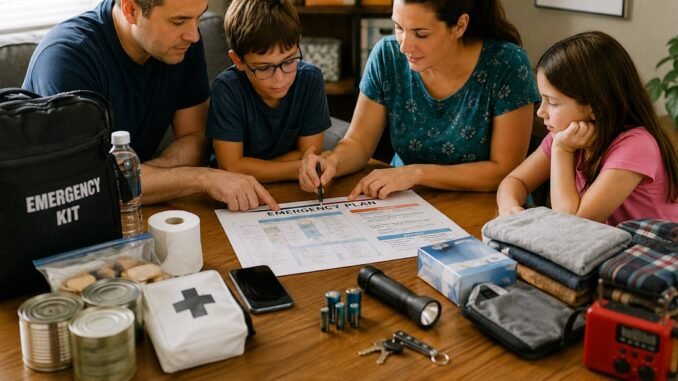
Here’s the uncomfortable truth: in a real emergency — fire, earthquake, severe storm — your family won’t rise to the occasion. They’ll fall to the level of their preparation. And “we’ll figure it out” isn’t a plan; it’s a hope. If you’re asking how do I create a family emergency plan everyone understands, the goal is a plan so simple a scared 7-year-old can execute it: where to go, how to reach each other, and what to grab. One focused hour of planning plus one practice drill puts your family ahead of 90% of households.
The plan has five parts: meeting points, communication, go-bags, home hazards, and practice. Let’s build each one.
How Do I Create a Family Emergency Plan Everyone Understands? Start With Meeting Points
Emergencies scatter people. Your plan needs two meeting points that every family member memorizes:
- Right outside your home: a specific spot a safe distance from the house — the big oak tree, the neighbor’s driveway, the mailbox across the street. For fires, this is where everyone gathers for headcount. Pick it, walk to it together, point at it.
- Outside your neighborhood: in case your street is evacuated or inaccessible — a relative’s house, a library, a school, a specific store parking lot. Somewhere everyone can reach independently.
Make it physical: draw a simple map with both points marked, post it on the fridge, and put a copy in each kid’s backpack. For young kids, the rule is absolute: go to the meeting point and stay there — never go back inside for anything. Firefighters are unanimous on this: re-entry kills.
The Communication Plan (When Phones Don’t Work Normally)
In disasters, local calls often fail while long-distance or texts get through — and everyone’s first instinct (calling each other repeatedly) jams things further. Your plan:
- Designate an out-of-state contact: one relative or friend everyone calls or texts to check in. Out-of-area lines often work when local ones don’t. Every family member memorizes this number — yes, memorizes, because phones die and get lost. Put it on a card in wallets and backpacks too.
- Text, don’t call: texts use less bandwidth and often go through when calls won’t. Agree: emergency = text the out-of-state contact “SAFE + location.”
- Know the backups: a battery or hand-crank radio ($25–$40) for official info when cell networks fail; your county’s emergency alert sign-up (most US counties have text alerts — sign up today, it takes 2 minutes).
- Kids’ school/daycare plans: know their emergency procedures and pickup authorization rules now. In a regional emergency, don’t drive toward danger to reach them — schools have protocols; follow them.
Ready.gov’s family plan resources (FEMA’s official site) offer printable templates that walk through all of this step by step.
Go-Bags: What to Grab in 60 Seconds
One bag per person, stored by the front door or in the car trunk, packed to sustain you for 72 hours:
- Documents: copies (physical + a USB drive) of IDs, insurance cards, prescriptions, bank info, emergency contacts. A fireproof document bag ($20–$30) for originals.
- Water + food: 1 gallon per person per day is the rule, but for a grab bag: water pouches, energy bars, and a portable filter ($20 LifeStraw). Rotate food yearly.
- Meds + first aid: 7-day supply of prescription meds (rotate!), basic first aid kit, glasses/contacts backup.
- Clothes + warmth: one change of clothes, warm layer, rain poncho, sturdy shoes by the bed (for earthquakes/fires at night — never evacuate barefoot).
- Tools: flashlight + batteries, phone charger/battery bank, whistle (for signaling if trapped), $100+ in small bills (ATMs fail in outages), local paper map.
- Kids: comfort item, diapers/formula if applicable, a laminated card with parents’ numbers and the out-of-state contact.
- Pets: carrier, leash, 3 days of food, water, vet records, a photo of you with your pet (proves ownership at shelters).
Total cost per bag: $75–$150 assembled gradually. Build one per month if the upfront cost stings — a half-built bag beats no bag.
Home Hazards and Shut-Offs (The 15-Minute Walk-Through)
Walk through your home together and handle these:
- Everyone old enough learns: where the water shut-off, gas shut-off, and breaker box are, and how to operate them. Label them with tags.
- Secure the big stuff: strap water heaters and tall bookcases to walls (earthquake zones especially), know where fire extinguishers are (kitchen + garage minimum) and that everyone teen+ knows PASS: Pull, Aim, Squeeze, Sweep.
- Smoke/CO detectors: test monthly, batteries yearly (or 10-year sealed units, $25 each — worth it). One per bedroom, one per floor minimum.
- Escape routes: two ways out of every bedroom (door + window). If upper floors, an escape ladder ($35–$50) stored accessibly — and practice deploying it.
Practice: The Drill That Makes It Real
A plan nobody’s rehearsed is a wish. Twice a year, run a 20-minute drill:
- Pick a scenario: house fire (most universal).
- Sound the alarm, everyone executes: get low, get out, go to the meeting point, headcount.
- Time it. Talk about what was confusing. Fix it.
- Make it age-appropriate, not terrifying: for young kids, frame it as “the safety game” — serious but not scary. Ready.gov’s kids section has great age-appropriate materials.
After the drill, update the plan: new phone numbers, new medications, kids old enough for new responsibilities. The plan is a living document — review it when clocks change (easy memory trigger).
Special Situations Your Plan Should Cover
The basic plan handles fire and storms. These scenarios need extra thought: Family members with disabilities or medical needs: assign a buddy to anyone who needs evacuation assistance — specific person, specific role, practiced. Keep a 2-week medication supply in the go-bag (rotated), plus a written medical summary (conditions, allergies, devices) that a stranger could hand to paramedics. Register with your county’s special-needs registry if one exists — first responders check these lists.
Elderly relatives nearby: fold them into your plan explicitly — who checks on them, how, and what’s the trigger? A phone tree fails if the power’s out; designate an in-person check. Separated families: if kids split time between households, both homes need the full plan — meeting points, go-bags, the out-of-state contact. Coordinate with your co-parent; emergencies don’t respect custody schedules. Pets beyond cats and dogs: reptiles need heat packs, fish need battery air pumps, birds need covered carriers to stay calm — a generic pet emergency kit covers the basics, but exotic pets need species-specific additions. And practice the plan at night once a year — emergencies don’t wait for daylight, and a dark-house drill reveals gaps (missing flashlights, confusing layouts) that daytime practice hides.
Keep the go-bag accessible, not buried: a go-bag in the back of a jammed closet might as well not exist. Store bags by the front door or in the car trunk, and keep the path to them clear — which is one more reason a clutter-free home isn’t just aesthetic, it’s a safety feature. In an evacuation, seconds matter; don’t spend them excavating.
The Bottom Line
A family emergency plan everyone understands needs: two memorized meeting points, an out-of-state contact with a text-don’t-call rule, a go-bag per person, a home walk-through covering shut-offs and escape routes, and a twice-yearly drill. Do the planning hour this weekend and the first drill next weekend. It’s the highest-value hour you’ll spend on your family’s safety all year — because the plan you hope you’ll never need is the one you’ll be most grateful to have.
Leave a Reply