
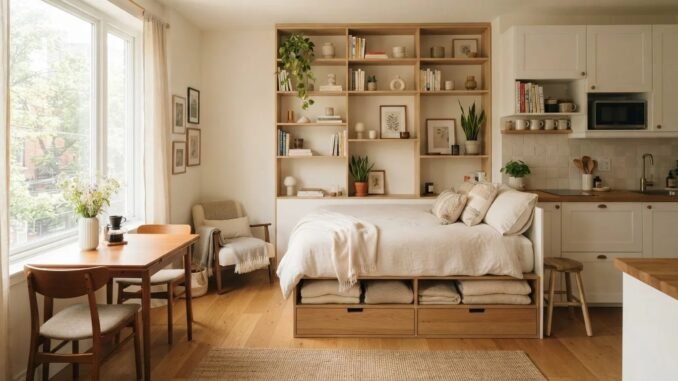
I lived in a 480-square-foot studio for three years, and I learned more about organization there than in a decade of bigger places. Small apartments don’t forgive clutter — there’s nowhere for it to hide. But here’s the flip side: small spaces are actually easier to organize, because every system is small and every win is visible. So what is the best way to organize a small apartment? Think vertical, think dual-purpose, and think ruthless about what earns its square footage.
The core principle: in a small apartment, every item needs a home, and every home needs to be findable in the dark. If you can’t put something away in 30 seconds, the system is too complicated and clutter will win. Here’s the room-by-room playbook.
What Is the Best Way to Organize a Small Apartment? Go Vertical First
Your floor space is fixed; your wall space is an untapped second apartment. Before buying any organizer, look up. Floating shelves above desks, over toilets, and along hallway walls add storage without touching the floor. A $25 set of floating shelves from Amazon or IKEA’s LACK shelves ($10 to $15 each) can hold books, plants, and baskets that would otherwise eat a whole bookcase footprint.
Over-the-door organizers are the small-apartment cheat code: shoes, cleaning supplies, pantry items, bathroom products — a $15 over-door rack from Walmart adds the equivalent of a small closet. And don’t ignore the backs of cabinet doors: adhesive hooks and slim racks inside kitchen and bathroom cabinets corral spices, hair tools, and cleaning bottles in dead space. Apartment Therapy’s small-space guides are full of renter-friendly versions of these that don’t damage walls.
The Living Area: Zones Beat Square Footage
In a studio or one-bedroom, one room does five jobs. Define zones with rugs, lighting, and furniture placement so your brain reads “office corner” and “relaxation corner” instead of “one cramped room.” A bookshelf turned perpendicular to the wall makes an excellent room divider that also stores things — IKEA’s KALLAX ($70 to $130 depending on size) is the classic for a reason, and the cubes fit $5 fabric bins that hide everything.
Furniture must earn its keep twice. A storage ottoman ($40 to $80) holds blankets and doubles as seating. A lift-top coffee table hides remotes, chargers, and laptops. If your dining table is also your desk, a rolling cart ($30 at IKEA or Target) becomes your “office” — wheel it to a closet when work ends, and the apartment stops feeling like a cubicle. Before buying anything new, do a pass of decluttering without getting overwhelmed — organizing stuff you don’t need is just expensive rearranging.
Conquer the cord and paper chaos
Two invisible clutter sources ruin small apartments: cables and paper. A $12 cable management box plus adhesive cord clips tames the tangle behind the TV and desk. For paper, go nuclear: a small filing box for the essentials (lease, taxes, medical), and photograph or shred everything else. Most bills and statements are available online — you don’t need the paper.
The Kitchen: Small but Mighty
Small kitchens punish single-use gadgets. The air fryer you use twice a year is stealing a cubic foot. Keep the true multi-taskers — a good chef’s knife, one large pot, a sheet pan, a cutting board — and relocate the rest to a high shelf or donate it.
- Use the cabinet doors: mount spice racks, lid organizers, and measuring-cup hooks inside doors.
- Stack vertically: shelf risers ($12 for a set) double cabinet capacity for mugs and plates.
- Magnetic strips: a $10 magnetic knife strip on the wall frees an entire drawer.
- Decant the bulky: flour, rice, cereal, and snacks in uniform clear containers stack neatly and — bonus — you can actually see when you’re running low.
- The fridge door is prime real estate: a magnetic spice rack or paper-towel holder on the side of the fridge uses zero counter space.
Bedroom and Closet: The 80/20 Wardrobe
You wear 20 percent of your clothes 80 percent of the time. In a small closet, that math is law. Keep the current-season favorites accessible, store off-season clothes in vacuum bags under the bed ($15 for a set at Target — they compress bulky sweaters to flat pancakes), and donate whatever hasn’t been worn in a year.
Slim velvet hangers ($20 for 50 on Amazon) instantly create 30 percent more rod space versus bulky plastic ones. A hanging shoe organizer on the closet door beats a shoe rack on the floor. And under-bed storage bins ($10 to $20 each) swallow shoes, linens, and luggage. If pets share the space, check out low-maintenance pets for apartment living — the right pet plus the right setup keeps small spaces harmonious.
Bathroom: Decant and Hang
Small bathrooms drown in half-empty bottles. Decant shampoo, conditioner, and soap into matching dispensers — it looks better and takes less space. A shower caddy that hangs from the showerhead ($12) beats one sitting in the tub. Over-toilet shelving units ($30 to $50) add two shelves of storage in zero floor space. And keep only daily-use items on the counter; everything else lives in a labeled bin under the sink.
The Maintenance System (5 Minutes a Day)
Organization in a small apartment is a daily practice, not a project. The whole system runs on one habit: the evening reset. Five minutes before bed, walk the apartment with a basket — everything out of place goes in the basket, then the basket gets emptied to the right homes. Laundry in the hamper, dishes in the sink, mail in the tray. That’s it. Small spaces stay organized through tiny daily corrections, not heroic weekend purges.
The Bottom Line
Organizing a small apartment comes down to three moves: use the walls, make furniture do double duty, and own less stuff. Start with one room this weekend — the kitchen or bedroom gives the fastest payoff — and spend under $50 on your first round of organizers. You don’t need a bigger apartment. You need every inch working as hard as you do.
Leave a Reply