
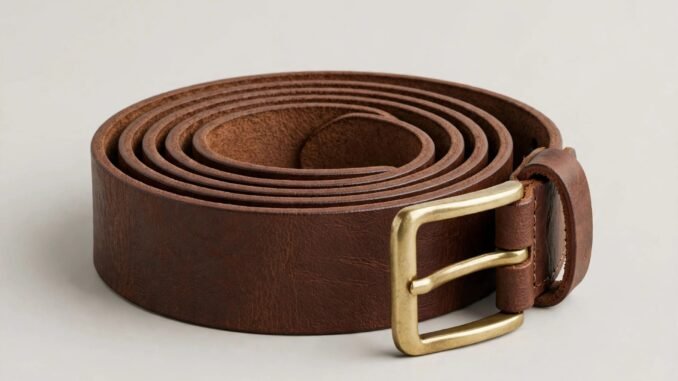
You order a “size 34” belt for your 34-waist pants. It arrives, and the only hole that works is the last one — or worse, none of them. How do I pick the right belt size for my waist? Belt sizing is one of fashion’s quiet confusing zones: belt sizes don’t match pant sizes the way you’d expect, men’s and women’s belts size differently, and the “right” fit depends on where you actually wear the belt (which isn’t always your pant size). Get it wrong and the belt is useless; get it right and it’s invisible — which is exactly what a good belt should be.
Here’s the complete sizing guide, plus the style rules that make belts work.
How Do I Pick the Right Belt Size for My Waist? The Measurement Method
The reliable method: measure a belt you already own that fits well — from the buckle’s fold (where the leather meets the buckle) to the hole you use most. That measurement in inches IS your belt size. No belt to measure? Measure your waist/hips where you’ll wear the belt (through belt loops, over the clothes you’ll wear it with), then add 2 inches. That total is your belt size.
Why Pant Size Doesn’t Equal Belt Size
Here’s the trap: a “34” pant rarely measures 34 inches (vanity sizing), and belts are measured to the middle hole with 2 inches of adjustment built in. The industry rule of thumb: order a belt 2 inches larger than your pant size (34 pants → 36 belt). This puts the buckle on the middle hole, leaving room to tighten or loosen. If you’re between sizes, size up — a slightly long belt tucks or can be punched; a short belt is useless.
- Men’s belts: sized in even inches (32, 34, 36, 38…), measured buckle-fold to middle hole. The +2 rule from pant size works reliably.
- Women’s belts: sized S/M/L or in inches — less standardized. Measure where you’ll wear it (waist vs. hips differ by inches) and compare to the brand’s chart. Online sizing principles apply.
- The fit test: the belt should fasten on the middle hole with a comfortable fit — one hole tighter and one looser available. Fastening on the last hole = too small; on the first hole with lots of tail = too big (though a cobbler can punch holes and trim for $10–$15).
Belt Width and Style Rules
- Width: dress belts 1–1.25″ (suit pants have narrow loops), casual belts 1.25–1.5″ (jeans have wider loops). Match belt width to your belt loops — a skinny belt swimming in wide loops looks wrong, and a wide belt won’t fit dress-pant loops at all.
- Match your shoes: the classic rule — belt color matches shoe color (black belt + black shoes, brown belt + brown shoes), and metals match (gold buckle + gold watch). For casual wear this relaxes, but for dress occasions it’s still the standard.
- Match your metals: silver buckle with silver watch/jewelry, gold with gold. The details register subconsciously.
- Dress belts: simple, unadorned, quality leather, minimal buckle. The belt should disappear into the outfit.
- Casual belts: more latitude — woven, braided (infinitely adjustable — the fit-forgiving champion), canvas, western styles. Braided belts are the secret weapon for in-between sizes.
- Women’s statement belts: wide belts over dresses and sweaters (see belting oversized knits) — here the belt is jewelry, sized to your waist over clothes.
Quality Check (Worth Knowing)
- Full-grain leather lasts decades; “genuine leather” (the grade, confusingly) is the bottom tier and cracks in a year or two. At $30–$60, look for full-grain from reputable makers.
- Stitching: even, tight, no loose threads. Glued-only belts delaminate.
- Buckle: solid (not hollow) metal, smooth mechanism. The buckle is the visible part — it should feel substantial.
- Edge finishing: burnished/painted edges that are smooth, not raw and fuzzy.
Good belts are thrift-store gold — quality leather belts for $3–$8 (thrift strategies), since belts barely wear out and sizes are adjustable. And like all leather goods, leather conditioning keeps them supple for decades.
For visual sizing guides, Real Men Real Style’s belt guide covers men’s sizing thoroughly, and most quality belt makers (Hanks, Anson) publish excellent measurement charts.
Belt Care and Lifespan
A quality leather belt lasts decades with minimal care — and neglected ones crack in two years. Roll, don’t fold: store belts rolled (buckle outside) or hung — folding creases leather permanently. Condition yearly: a light coat of leather conditioner keeps the strap supple; dry, cracked belts snap at the holes. Rotate: daily wear stretches the favorite hole — rotating 2–3 belts extends each one’s life dramatically (the same rotation principle as shoe rotation). Hole maintenance: if holes stretch or tear, a cobbler punches clean new ones for a few dollars — don’t keep using a blown-out hole. Buckle care: polish metal buckles occasionally; replace the buckle (not the whole belt) if the finish wears — most quality belts have removable buckles. A $60 full-grain belt with this care outlives five $20 bonded-leather belts — and looks better every year as it develops patina. Like all leather goods, buy once and maintain.
The Belt Collection: What You Actually Need
How many belts does one person need? Fewer than you think. Men: two — one black dress belt (1.25″, simple buckle) and one brown casual belt (1.5″, for jeans and chinos). That covers every outfit. A third (woven or canvas) is a nice summer addition, not a necessity. Women: three — one black classic, one brown/tan classic, one statement wide belt for dresses and sweaters. Everything else is optional. Buy the classics in full-grain leather ($40–$60 each), and they’ll outlast every trend cycle. The belt drawer full of cheap, cracked, barely-worn belts is the accessory equivalent of the closet full of nothing-to-wear — a few good ones beat a dozen bad ones in every way that matters.
The practical takeaway: measure a fitting belt buckle-to-favorite-hole (that’s your size), or add 2″ to your pant size. Aim for the middle hole, match width to loops and color to shoes, and buy full-grain leather. A $40 belt that fits perfectly outlasts and outclasses a $150 belt in the wrong size.
Leave a Reply