
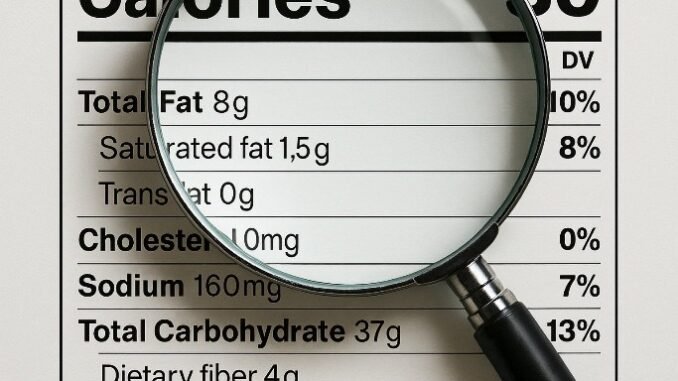
You flip over the box, stare at the grid of numbers and percentages, and your eyes glaze over by the third line. How do I read a nutrition label to make healthier choices? The FDA redesigned the Nutrition Facts label in recent years to be more useful — bigger calorie numbers, a dedicated “added sugars” line, more realistic serving sizes — but most of us were never actually taught how to use it. I spent years either ignoring labels entirely or obsessing over the wrong numbers. Here’s the practical way to read a label in about 30 seconds and actually make a better choice.
The secret: read labels in a specific order, focus on about five things, and ignore most of the rest.
How Do I Read a Nutrition Label to Make Healthier Choices? The 30-Second Method
Step 1: Check the Serving Size (The Trap)
Everything on the label is per serving — not per package. That innocent-looking bottle of iced tea? Two servings. The “190 calories” you saw is actually 380 if you drink the whole thing. Cereal boxes are notorious: a “serving” might be 3/4 cup, while most people pour 2 cups. Always multiply by what you’ll actually eat. The updated labels now use more realistic serving sizes and require dual-column labels (per serving AND per package) on foods likely to be eaten in one sitting — a genuinely helpful change.
Step 2: Glance at Calories
Calories are now the biggest, boldest number on the label — use them as a quick reality check. A 500-calorie “snack” bar isn’t a snack; it’s a meal. But don’t stop here: 200 calories of almonds and 200 calories of candy affect your body very differently. Calories tell you the quantity; the next steps tell you the quality.
Step 3: Limit These Three
Added sugars: the label now separates these from naturally occurring sugars — this is the most valuable addition to the new label. The daily limit is 50 grams (about 12 teaspoons) on a 2,000-calorie diet, but the American Heart Association suggests staying under 25g (women) or 36g (men). One 12-oz soda has about 39g. Flavored yogurts, “healthy” granola bars, pasta sauces, and bread can all hide shocking amounts. If added sugars are more than ~8–10g per serving in something you eat daily, look for a better option.
Sodium: limit is 2,300mg per day, but the average American eats over 3,400mg — mostly from processed foods, not the salt shaker. Bread, soup, deli meat, frozen meals, and restaurant food are the big sources. As a rule of thumb, a single item with 20%+ Daily Value of sodium is high; 5% or less is low.
Saturated fat: keep under 10% of daily calories (about 13g on a 2,000-calorie diet). It’s concentrated in fatty meats, butter, cheese, coconut oil, and pastries. Trans fat should be as close to zero as possible — check that the label says 0g and scan ingredients for “partially hydrogenated oils.”
Step 4: Seek These (But Don’t Obsess)
Fiber: most Americans get about half the recommended 25–30g daily. A product with 3g+ fiber per serving is decent; 5g+ is good. Fiber is the unsung hero — it feeds gut bacteria, steadies blood sugar, and keeps you full.
Protein: useful for comparing similar products (Greek yogurt vs. regular, for instance). There’s no %DV target to hit per item — just use it comparatively.
Vitamins and minerals: the label now lists vitamin D, calcium, iron, and potassium with actual amounts. Potassium is worth a glance — most people under-consume it, and it helps counteract sodium’s blood pressure effects.
The Ingredient List: The Label’s Honest Section
Ingredients are listed by weight, descending. This is where marketing meets reality:
- First ingredient matters most. “Whole wheat flour” as ingredient #1 is a different product than “enriched wheat flour” (refined flour with nutrients added back) as #1 with whole wheat appearing fourth.
- Shorter is usually better — not always, but a 40-ingredient “bread” is doing a lot of things bread doesn’t need.
- Sugar has aliases. Cane syrup, dextrose, maltose, fruit juice concentrate, agave nectar — if three different sugars appear in the first five ingredients, it’s dessert wearing a health costume. The “added sugars” line on the nutrition panel now catches this, but the ingredient list shows you the trick.
- “Natural flavors” is a vague term covering hundreds of compounds — not necessarily bad, but not meaningful either.
Front-of-Package Claims: Translate the Marketing
The front of the box is advertising; the back is (regulated) information. Quick translations:
- “Low fat” often means high sugar (they replaced the fat with something).
- “Multigrain” just means multiple grains — they can all be refined. Look for “100% whole grain.”
- “No added sugar” can still mean high natural sugar (looking at you, fruit juice).
- “Gluten-free” is essential for celiac disease and irrelevant for everyone else — it’s not a health halo.
- “Made with real fruit/whole grains” tells you nothing about how much.
The 30-second rule I actually use in the store: serving size realistic? Calories sane? Added sugars low? Sodium not crazy? Ingredients recognizable? If it passes those five, it goes in the cart. This skill compounds with knowing how much sugar is too much per day and building a balanced meal plan on a budget — label reading is what makes the grocery trip match the plan.
The FDA’s guide to using the Nutrition Facts label walks through every line with examples, and the American Heart Association’s label-reading tips focus on the heart-health angles.
Putting It Into Practice: The Aisle Test
Next grocery trip, try this experiment: pick your usual yogurt, cereal, or pasta sauce and compare it against two competitors using the 30-second method. You’ll be stunned how often the “healthy-looking” option loses to the plain one — the Greek yogurt with 22g of added sugar versus the plain with zero, the “whole grain” cereal with 16g sugar versus the boring-looking one with 6g. Do this for your five most-bought packaged foods and you’ll permanently upgrade your cart with maybe 10 minutes of effort. One more pro move: shop mostly from the store’s perimeter (produce, dairy, meat, bakery) where most items don’t even have nutrition labels — that’s not a coincidence. The fewer labels you need to read, the better you’re eating. Use your label skills as a filter for the center aisles, not a lifestyle.
The practical takeaway: read labels back-to-front in this order — serving size, calories, added sugars, sodium, saturated fat, then the ingredient list. Ignore front-of-package marketing. Five checks, 30 seconds, dramatically better grocery cart.
Leave a Reply