
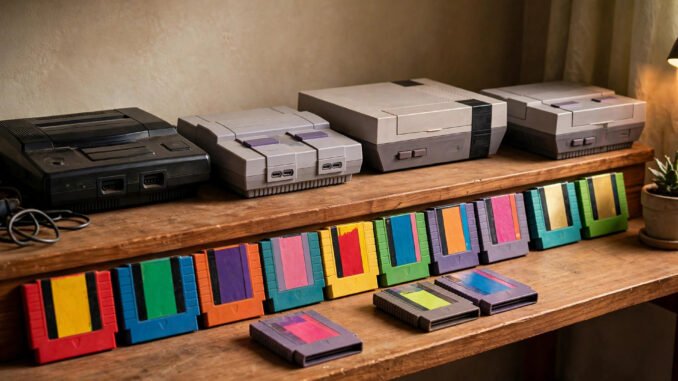
How much does building a retro game collection really cost in Phoenix, Arizona? The TikTok version shows walls of pristine cartridges and makes it look like a rich person’s hobby. The reality is more interesting: retro collecting in 2026 is a market with real price data, real bargains, and real traps — and Phoenix is genuinely one of the better American cities for it. This guide gives you honest numbers: what starter, intermediate, and serious collections cost, where Phoenix collectors actually hunt, and how to avoid the overpaying mistakes beginners make.
The Market in 2026: What Things Actually Cost
Retro game prices are among the most transparent in all of collecting thanks to PriceCharting, which aggregates actual eBay sold listings — not asking prices, sold prices. Always check there before buying anything. Here’s the landscape:
The cheap seats: 80% of the fun for 20% of the money
Most retro games are cheap. Common NES, SNES, Genesis, and PS1 titles in cartridge/disc-only condition run $5–$20. A starter library of 30 beloved games — Super Mario Bros. 3, Sonic 2, Tetris, Street Fighter II, Tony Hawk’s Pro Skater 2 — costs roughly $200–$400 total. The expensive reputation comes from a thin layer of grails, not the hobby’s bulk.
The mid-tier: where collecting gets real ($20–$100/game)
Fan favorites in complete-in-box condition: Chrono Trigger ($100+ loose, $300+ complete), EarthBound ($200+ loose), Pokémon boxed sets, Fire Emblem. A focused 50-game collection of quality titles, mixed loose and complete, typically runs $1,500–$4,000. This is where most serious-but-sane collectors live.
The grails: where money goes to show off ($200–$10,000+)
Sealed copies, rare variants, and legendary titles (Stadium Events, Nintendo World Championship carts, Panzer Dragoon Saga) command four and five figures. This tier is speculation as much as collecting — exciting, but not where beginners belong.
Hardware: the hidden budget line
Consoles themselves: NES ($80–$120), SNES ($90–$130), Genesis ($60–$90), N64 ($100–$140), GameCube ($90–$130) — all loose-console prices in 2026. CRT televisions, the display purists want, are free-to-$50 on local marketplaces (people give them away). Modern upscalers (RetroTINK) run $100–$300 if you want retro on a modern TV. Budget $300–$600 for a solid multi-console hardware setup.
Why Phoenix Is a Good Hunting Ground
Phoenix has structural advantages for retro collectors. It’s a sprawling metro with decades of suburban accumulation — attics full of 80s/90s childhoods. The snowbird effect means estate sales and downsizing sales run year-round, not just in spring. And Arizona’s dry climate is kind to cartridges and cardboard boxes — less moisture damage than Florida or the Pacific Northwest.
Where Phoenix collectors hunt: Bookmans (the beloved Arizona entertainment exchange — multiple Valley locations, fair prices, trade-in credit), local game stores in Mesa/Tempe/Chandler (call around; the good ones post new arrivals on social media), estate sales (estate sales listing sites, filtered for “video games” — the best scores come from non-collector estates where games are priced as toys), Goodwill and thrift stores (rare jackpots, requires persistence — our thrift store shopping tips for beginners apply directly), and the Phoenix Retro Games community (swap meets and conventions where collectors trade at fair prices without eBay’s 13% fee cut).
Phoenix pricing reality: expect to pay 10–20% below eBay sold prices at local stores (no shipping, no fees, inspect-in-hand), and 40–70% below at estate sales and thrift finds — when you get lucky. Flea markets (like the weekend markets around the Valley) sit in between.
Three Collection Budgets That Work
The $500 starter: one console ($100) + CRT or upscaler ($0–$100) + 20 common games ($200–$300). You own a real, playable collection of classics within a month. This is the smart entry — prove the hobby’s joy before spending more.
The $2,000 enthusiast: 3–4 consoles ($400) + display solution ($200) + 40–60 games mixing common and mid-tier ($1,200–$1,500). A collection you’re proud to show off, built over 6–12 months of hunting. The hunt itself becomes half the fun.
The $5,000+ focused collector: complete-in-box sets, a grail or two, graded or sealed pieces. Only enter this tier with a focus (one console’s full library, one franchise, one genre) — unfocused spending at this level just builds expensive clutter. And set a real budget first: our guide to creating a budget you can actually stick to is essential reading before hobby money gets serious.
Beginner Traps That Waste Money
Buying graded/slabbed games as a beginner. Grading adds huge premiums for plastic-encased games you can’t play. It’s speculation, not collecting — skip until you deeply understand the market.
“Rare” listings that aren’t rare. Sellers label everything “RARE!!!” — check PriceCharting sold listings, not asking prices. A game listed at $80 that consistently sells for $25 isn’t rare; it’s overpriced.
Reproductions sold as originals. The repro market is huge — fine if labeled and priced as repros ($20–$40), fraud if sold as authentic. Learn the tells (label quality, board markings, shell texture) before buying expensive cartridges from strangers.
Completing sets for completion’s sake. Full-set collecting means buying dozens of terrible games. Collect what you love playing or displaying — “I own every SNES game” impresses no one as much as a curated shelf of favorites.
Ignoring condition economics. For common games, condition barely affects price — buy the $8 copy, not the $25 “mint” one. For expensive games, condition is everything — a crushed box can halve value. Match your pickiness to the price tier.
Conclusion: A Hobby With Honest Prices
Building a retro game collection in Phoenix really costs $500 for a joyful starter, $2,000 for an enthusiast’s shelf, and $5,000+ only if you develop a focused passion — with hardware adding $300–$600. Phoenix’s estate sales, Bookmans locations, dry climate, and collector community make it fertile hunting ground. Check PriceCharting before every purchase, hunt locally before buying online, collect what you love instead of what’s “rare,” and budget like the hobby deserves. The games are waiting in someone’s attic — in the Valley, probably within ten miles of you.
Frequently Asked Questions
How much does it cost to start a retro game collection?
A genuine starter collection — one console, a display solution, and ~20 classic games — costs about $500. Most beloved retro games are $5–$20 each; only a thin layer of rare titles commands high prices.
Where can I buy retro games in Phoenix?
Bookmans (multiple Valley locations), local game stores in Mesa/Tempe/Chandler, estate sales (best deals), thrift stores (rare jackpots), Valley flea markets, and local collector swap meets/conventions. Local prices typically run 10–20% below eBay.
Are retro games a good investment?
Buy to enjoy, not to invest. Some titles appreciated dramatically, but the market is volatile, grading is speculative, and most games hold steady or decline. Collectors who “invest” without deep market knowledge usually overpay. Treat any appreciation as a bonus.
How do I avoid fake retro games?
Check PriceCharting sold listings (not asking prices) to know real values, learn reproduction tells (label print quality, cartridge shell texture, circuit board markings), and buy expensive items from reputable local stores or graded from established services — never from too-good-to-be-true listings.
Should I buy a CRT TV for retro gaming?
For authenticity, yes — retro games were designed for CRTs, and they look best there. CRTs are often free or under $50 locally. If space is tight, a modern upscaler ($100–$300) on your current TV is a solid compromise.
Leave a Reply