
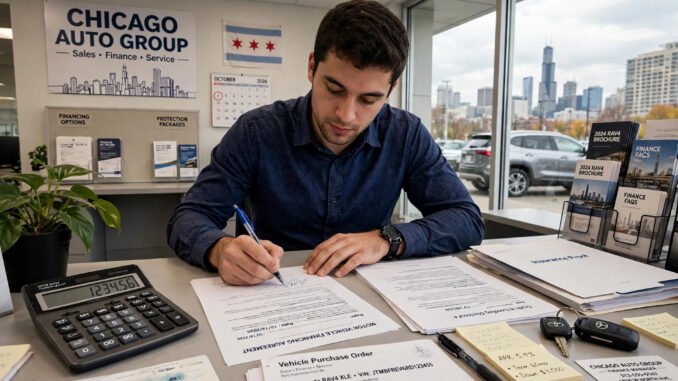
“Zero down, 0% APR, no payments for 90 days!” The banners outside Chicago dealerships promise free money. Inside, the finance office runs one of the most profitable operations in retail — and the profit comes from buyers who do not understand the deal they just signed. Car financing is not complicated, but it is deliberately confusing: the monthly payment is emphasized, the total cost is buried, and the add-ons are pure margin. This guide decodes car financing deals on a tight budget in Chicago, so you sign only what you understand.
The Four Numbers That Matter (Ignore Everything Else)
Every financing deal reduces to four numbers: 1. Vehicle price — the negotiated selling price before anything else. 2. APR — the annual interest rate; in 2026, Chicago buyers with good credit (700+) see roughly 6–7% on 60-month used-car loans and 5–6% on new; fair credit (650–699) sees 9–12%. 3. Term — the loan length in months. 4. Down payment / trade-in value. Everything else — monthly payment, “total due at signing,” rebates — derives from these four. Any deal you cannot reduce to these four numbers is a deal you should not sign.
The Consumer Financial Protection Bureau’s auto-loan guide explains how to read these figures on actual loan documents — bookmark it before you shop, along with the FTC’s consumer advice on auto financing.
The Monthly-Payment Trap
Dealers steer every conversation to monthly payment because it hides total cost. Watch the math: a $25,000 car at 7% APR costs $495/month for 60 months = $29,700 total. Stretch it to 84 months and the payment drops to an attractive $376/month — but the total becomes $31,584, nearly $2,000 more, and you will owe more than the car is worth for most of the loan (underwater). The 84-month loan is how dealers sell cars people cannot afford: the payment fits, the finances do not.
Rules: Never finance longer than 60 months on a used car (depreciation outruns payments beyond that). Put at least 10–20% down to avoid starting underwater. Negotiate price first, financing second — settle the vehicle’s selling price before discussing how you will pay; combining them lets dealers give with one hand and take with the other. And always ask for the “out-the-door” total: price + taxes + fees − down payment = amount financed. If they will not show it clearly, leave.
0% APR Deals: Read the Fine Print
Manufacturer 0% APR offers are real — but they are not for everyone and not always the best deal. The catches: Credit requirements — typically 720+ scores; most buyers do not qualify and get switched to standard rates mid-process. Shorter terms — usually 36–48 months, meaning higher payments despite zero interest. Rebate forfeiture — you often must choose between 0% APR or a cash rebate ($2,000–$4,000); on many models the rebate plus a low bank rate beats 0%. New cars only — never available on used vehicles. Do the math both ways before choosing: (0% × shorter term) versus (rebate + bank APR × longer term). Frequently the rebate wins.
Pre-Approval: Your Strongest Negotiating Tool
Before visiting any Chicago dealer, get pre-approved from your bank or a credit union. Chicago-area credit unions routinely beat dealer-arranged rates by 1–3 percentage points — on a $25,000 loan, 2% less APR saves roughly $1,500 over 60 months. Pre-approval does three things: it sets your real budget (removing the dealer’s ability to stretch you), it gives you a rate to beat (let the dealer’s finance office try — sometimes manufacturer-subsidized rates win), and it converts you from a “payment buyer” into a “cash buyer” psychologically — you negotiate price like someone writing a check.
Check your rate options against neutral benchmarks, and understand your rights around add-on products via the CFPB resources above. If the car will handle your daily grind, our tips for making your commute more enjoyable will pay dividends long after the loan is signed — and if road trips are in your future, see how to plan a US road trip once the keys are yours.
The Finance Office Gauntlet: Add-Ons Ranked
After you agree on price, the finance manager presents the real profit center. Ranked by how hard to decline: Extended warranties — marked up 100–300%; the $2,500 warranty costs the dealer ~$800. On a reliable used car with a pre-purchase inspection, usually a bad bet; on complex luxury vehicles, sometimes reasonable — but buy it from your credit union or insurer for half the price, never in the finance office. GAP insurance — useful if you are underwater (small down payment), but $500–$800 at the dealer versus $200–$300 from your insurer. VIN etching — $200–$400 for a $25 DIY kit; pure profit. Paint/fabric protection — $500–$1,000 for wax and Scotchgard; decline always. Tire-and-wheel protection — occasionally worthwhile on Chicago’s pothole-ravaged streets, but negotiable to half the asking price. LoJack/stolen-vehicle recovery — your phone’s location services and a $30 AirTag do 90% of this.
The script: “No thank you” on repeat, politely, without justification. Justifications invite rebuttals; “no” ends the pitch. Every add-on can be purchased later, cheaper, elsewhere — nothing in that office is now-or-never, whatever the urgency implies.
Chicago-Specific Financing Notes
Sales tax: Chicago’s combined rate on vehicles runs about 8.25%+ (state, county, city) — on a $25,000 car, that is ~$2,060, a meaningful chunk of “tight budget” math. Documentation fees: Illinois caps doc fees (~$350 in 2026) — far saner than Florida’s $1,000+ dealer fees, but verify the number on the buyer’s order. Winter reality: If financing a vehicle for Chicago winters, factor the cost of winter tires ($600–$800 mounted) — financing an AWD vehicle does not eliminate the need for proper tires, and dealers will not mention it. Trade-ins: Get a CarMax/Carvana quote before the dealer appraises — it takes 20 minutes online and gives you a floor number the dealer must beat.
Conclusion
Understanding car financing deals in Chicago comes down to: reduce every offer to price, APR, term, and down payment; never finance used cars beyond 60 months; arrive with credit-union pre-approval; negotiate price before financing; do the 0%-versus-rebate math; and decline every finance-office add-on (buying the useful ones elsewhere for half). The dealer is not your adversary — but the finance office is a profit center, and informed buyers are its least profitable customers. Be one.
Frequently Asked Questions
What is a good APR for a car loan in 2026?
Roughly 5–7% for new cars and 6–7% for used with good credit (700+); 9–12% with fair credit (650–699). Credit-union pre-approval typically beats dealer-arranged rates by 1–3 points.
Should I take 0% APR or a cash rebate?
Do the math both ways. You usually must choose one or the other; the rebate plus a low bank rate often beats 0% APR, especially since 0% deals require top-tier credit and shorter terms.
How long should my car loan be?
60 months maximum for used cars (longer terms leave you underwater as depreciation outruns payments). Shorter is better if the payment fits your budget.
Are extended warranties from dealers worth it?
Rarely at dealer prices — they are marked up 100–300%. If you want one, buy from your credit union or insurer for roughly half the finance-office price.
What fees are legitimate at a Chicago dealership?
Sales tax (~8.25%), title/registration, and Illinois’s capped doc fee (~$350). Anything labeled as dealer prep, market adjustment, or mandatory add-ons is negotiable — negotiate or walk.
Leave a Reply